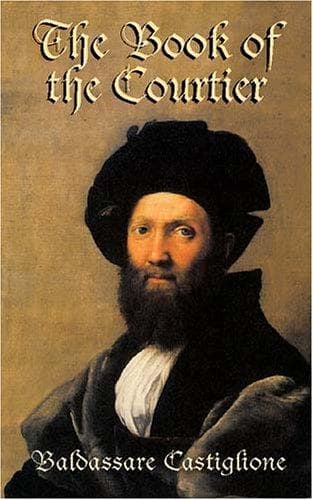
The Book of the CourtierCastiglione, Baldassarre, conte
History
The Book of the Courtier
Castiglione, Baldassarre, conte
Courtesy -- Early works to 1800; Courts and courtiers -- Early works to 1800
Note 14 page 3. GIOVANNI BOCCACCIO, (born 1313; died 1375), was the
natural son of a Florentine tradesman and a Frenchwoman with whom his
father had made acquaintance during a business residence at Paris. In
early manhood he engaged in commerce at Naples, and had but little
learning in his youth, although he studied law for a time. Erudition and
authorship became the serious enthusiasm of his life, owing (it is said)
to a chance visit to the supposed tomb of Virgil at Naples. In middle
life he began the study of Greek at his friend Petrarch’s suggestion;
and although he never acquired more than what would now be deemed a
superficial knowledge of that language, as a Hellenist he had no
precursor in Italy. An ardent if somewhat unappreciative admirer of
Dante (whose _Divina Commedia_ he transcribed with his own hands), he
was the first Italian author to write for the common people, instead of
composing books suited only to the learned and patrician classes. His
style was formed by tireless study of classic models, and became a
standard for imitation by his successors.
Note 15 page 3. It is now known that the considerations that led
Boccaccio to underrate his poems and tales, were ethical rather than
literary.
Note 16 page 5. THEOPHRASTUS, (born 374; died 287 B.C.), was a native of
Lesbos, but resided at Athens. He was the chief disciple and successor
of Aristotle, and wrote also upon a great variety of subjects other than
philosophy. His best known work, the “Characters,” is a collection of
sprightly sketches of human types. La Bruyère’s famous book of the same
name was originally a mere translation from Theophrastus. The incident
mentioned in the text is thus described in Cicero’s _Brutus_: “When he
asked a certain old woman for how much she would sell something, and she
answered him and added, 'Stranger, it can’t be had for less,'—he was
vexed at being taken for a stranger although he had grown old at Athens
and spoke to perfection.”
Note 17 page 5. I. e., pages 39-54.
Note 18 page 5. The reference here is to Plato’s “Republic,” Xenophon’s
_Cyropædia_, and Cicero’s _De Oratore_.
Note 19 page 6. In the letter quoted in note 13, Vittoria Colonna wrote:
“I do not marvel at your portraying a perfect courtier well, for by
merely holding a mirrour before you and considering your inward and
outward parts, you could describe him as you have; but our greatest
difficulty being to know ourselves, I say that it was more difficult for
you to portray yourself than another man.”
[Illustration:
FEDERICO DI MONTEFELTRO
DUKE OF URBINO
1422-1482
]
Reduced from Alinari’s photograph (no. 2686) of a marble bas-relief, in
the National Museum at Florence, by some attributed to Mino da
Fiesole (1431-1484).
Public-domain text, read in full here on John Shaqi.
Reviews
Reviews
No reviews yet
Be the first to share your thoughts on this work.
Elsewhere in the archive
Join the Discussion
Join the discussion
Sign in to leave a comment or review.
Sign InorCreate an account