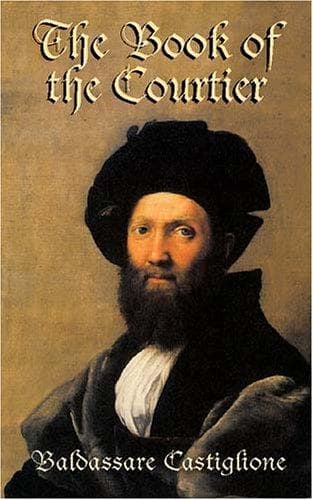
The Book of the CourtierCastiglione, Baldassarre, conte
History
The Book of the Courtier
Castiglione, Baldassarre, conte
Courtesy -- Early works to 1800; Courts and courtiers -- Early works to 1800
“Thus it is needful for our Courtier to be cautious in his every action,
and always to mingle good sense with what he says or does. And let him
not only take care that his separate parts and qualities are excellent,
but let him order the tenour of his life in such fashion, that the whole
may be in keeping with these parts and be seen to be always and in
everything accordant with his own self and form one single body of all
these good qualities; so that his every act may be the result and
compound of all his faculties, as the Stoics say is the duty of him who
is wise.
“Still, although in every action one faculty is always chief, yet all
are so enlinked together, that they make for one end and may all further
and serve every purpose. Hence he must know how to make the most of
them, and by means of contrast and as it were foil to the one, he must
make the other more clearly seen;—like good painters, who display and
show forth the lights of projecting objects by the use of shadow, and
likewise deepen the shadows of flat objects by means of light, and so
assemble their divers colours that both the one and the other are better
displayed by reason of that diversity, and the placing of figures in
opposition one to another aids them to perform that office which is the
painter’s aim.
“Thus gentleness is very admirable in a man of noble birth who is
valiant and strong. And as his boldness seems greater when accompanied
by modesty, so his modesty is enhanced and set off by his boldness.[153]
Hence to speak little, to do much, and not to boast of praiseworthy
deeds but to conceal them tactfully,—enhances both these attributes in
the case of one who knows how to employ this method with discretion; and
so it is with all other good qualities.
“Therefore in what our Courtier does or says I would have him follow a
few universal rules, which I think comprise briefly all that I have to
say. And for the first and most important let him above all avoid
affectation, as the Count rightly advised last evening. Next let him
consider well what thing it is that he is doing or saying, the place
where he is doing it, in whose presence, the cause that impels him, his
age, his profession, the object he has in view, and the means that may
conduce thereto; and so, with these precautions let him apply himself
discreetly to whatever he has a mind to do or say.”
8.—After messer Federico had spoken thus, he seemed to pause a little.
Whereupon my lord Morello da Ortona at once said:
“These rules of yours teach little, it seems to me; and for my part I
know as much about it now, as I did before you propounded them. Still I
remember having heard them several times before also from the friars to
whom I made confession, and who called them ‘the circumstances,’ I
think.”
Then messer Federico laughed and said:
Public-domain text, read in full here on John Shaqi.
Reviews
Reviews
No reviews yet
Be the first to share your thoughts on this work.
Elsewhere in the archive
Join the Discussion
Join the discussion
Sign in to leave a comment or review.
Sign InorCreate an account