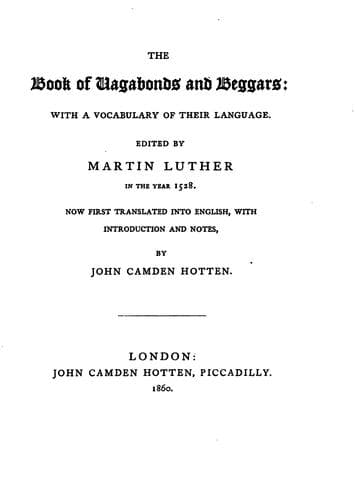
The Book of Vagabonds and Beggars, with a Vocabulary of Their Language
History
The Book of Vagabonds and Beggars, with a Vocabulary of Their Language
Begging -- Germany; German language -- Slang; Wayfaring life -- Germany
The iiij^{th} is about the KLENKNERS. These are the beggars who sit
at the church-doors, and attend fairs and church gatherings with sore
and broken legs; one has no foot, another no shank, a third no hand or
arm. _Item_, some have chains lying by them, saying they have lain in
captivity for innocence’ sake, and commonly they have a St. Sebastianum
or St. Lenhartum with them, and they pray and cry with a loud voice and
noisy lamentations for the sake of the Saints, and every third word one
of them speaks (BARL) is a lie (GEVOP), and the people who give alms
to him are cheated (BESEFELT),—inasmuch as his thigh or his foot has
rotted away in prison or in the stocks for wicked deeds. _Item_, one’s
hand has been chopped off in the quarrels over dice or for the sake
of a harlot. _Item_, many a one ties a leg up or besmears an arm with
salves, or walks on crutches, and all the while as little ails him as
other men. _Item_, at Utenheim there was a priest by name Master Hans
Ziegler (he holds now the benefice of Rosheim), and he had his niece
with him. One upon crutches came before his house. His niece carried
him a piece of bread. He said, “Wilt thou give me nought else?” She
said, “I have nought else.” He replied, “Thou old priest’s harlot! wilt
thou make thy parson rich?” and swore many oaths as big as he could
utter them. She cried and came into the room and told the priest. The
priest went out and ran after him. The beggar dropped his crutches
and fled so fast that the parson could not catch him. A short time
afterwards the parson’s house was burnt down; he said the KLENKNER did
it. _Item_, another true example: at Schletstat, one was sitting at
the church-door. This man had cut the leg of a thief from the gallows.
He put on the dead leg and tied his own leg up. He had a quarrel with
another beggar. This latter one ran off and told the townserjeant.
When he saw the serjeant coming he fled and left the sore leg behind
him and ran out of the town—a horse could hardly have overtaken him.
Soon afterwards he hung on the gallows at Achern, and the dry leg
beside him, and they called him Peter of Kreuzenach. _Item_, they are
the biggest blasphemers thou canst find who do such things; and they
have also the finest harlots (GLIDEN), they are the first-comers at
fairs and church-celebrations, and the last-goers therefrom.
_Conclusio_: Give them a kick on their hind parts if thou canst, for
they are nought but cheats (BESEFLER) of the peasants (HANZEN) and all
other men.
Example: One was called Uz of Lindau. He was at Ulm, in the hospital
there, for xiiij days, and on St. Sebastian’s day he lay before a
church, his hands and thighs tied up, nevertheless he could use both
legs and hands. This was betrayed to the constables. When he saw them
coming he fled from the town,—a horse could hardly have ran faster.
+Of Dobissers,[12] or Dopfers,+ _i.e._ +Church-mendicants.+
Public-domain text, read in full here on John Shaqi.
Reviews
Reviews
No reviews yet
Be the first to share your thoughts on this work.
Join the Discussion
Join the discussion
Sign in to leave a comment or review.
Sign InorCreate an account