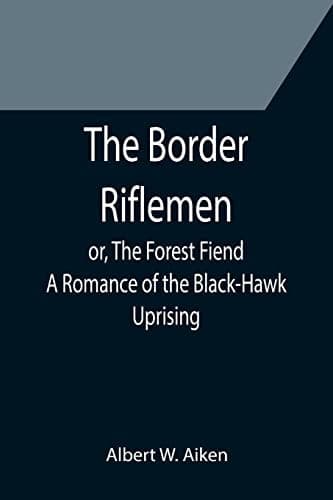
The Border Riflemen; or, The Forest Fiend. A Romance of the Black-Hawk UprisingAiken, Albert W.
General
The Border Riflemen; or, The Forest Fiend. A Romance of the Black-Hawk Uprising
Aiken, Albert W.
Black Hawk War, 1832 -- Fiction; Dime novels
“That they may come and take it again,” replied Black-Hawk, with a
bitter laugh. “Let us speak no more, for my tongue grows bitter in my
mouth. Sons of the Sac, let us go for corn.”
The Indian stalked away, followed by a shouting crowd of his adherents,
and Cooney Joe looked uneasily at Wescott.
“I don’t like this, ’square. You see our fellers ar’ mighty rough on the
Injins, and I heard some on ’em say that ef the Sacs came over to steal
corn they’d give ’em an all-fired lickin’. Now if they do that it means
war.”
“I hope our men will not be so impudent,” said Wescott. “They ought to
give the poor fellows a chance to carry away corn for their suffering
families, since they have dispossessed them of their land.”
Half an hour passed, when suddenly there came a great tumult from the
direction in which the Indians had gone. The shouts of men, the loud and
continuous barking of dogs, and the occasional crack of fire-arms, could
be heard.
Cooney Joe caught up his weapons, and followed by Mr. Wescott, hurried
away in the direction from which the sound came. They had not gone half
a mile when they came upon a great rabble of whites surrounding the
party which had come over for corn, abusing them in every possible way.
Showers of stone were hurled upon them, clods of earth and filth of
every description was cast upon them, and they were fighting their way
slowly back toward the stream, apparently unconscious of the insults
heaped upon them. Foremost among them, walking with a firm step, but
with a dark cloud gathering upon his brow, strode Black-Hawk. A stone
had struck him on the forehead, and the blood was trickling slowly down
his face, but he did not seem to be aware of the fact. Once or twice he
turned his head when some unusually vile epithet was heaped upon him,
with a haughty glance at the offender, which they remembered in the
after times, for two men who struck him, and whom he marked for
destruction, were the first to fall when the struggle commenced in
earnest.
“White men,” cried the chief, halting, at length. “Do not dare to stand
in the track of Black-Hawk, upon his own land.”
“Your land, you old thief,” roared a man named Churchill. “You lie! It
is ours—fairly bought—and we will keep it.”
“Black-Hawk does not waste words with a man with a double tongue, who is
only fit to sit with the women when the warriors are on the
battle-field,” replied the chief.
Churchill caught up a handful of sand and flung it into the face of the
old chief. Black-Hawk trembled in every limb but not with fear, and he
clenched his hands until the blood started from beneath his nails.
“Fool!” he hissed. “In the days to come, remember Black-Hawk!”
That the man had good cause to remember this insult, the history of that
time will show.
Public-domain text, read in full here on John Shaqi.
Reviews
Reviews
No reviews yet
Be the first to share your thoughts on this work.
Join the Discussion
Join the discussion
Sign in to leave a comment or review.
Sign InorCreate an account