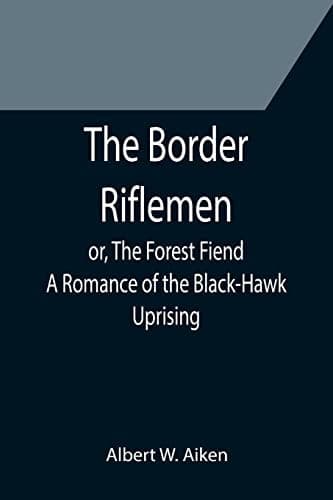
The Border Riflemen; or, The Forest Fiend. A Romance of the Black-Hawk UprisingAiken, Albert W.
General
The Border Riflemen; or, The Forest Fiend. A Romance of the Black-Hawk Uprising
Aiken, Albert W.
Black Hawk War, 1832 -- Fiction; Dime novels
Black-Hawk bounded to his feet with a terrible cry, and laid his hand
upon a weapon. But that Na-she-eschuck sprung between him and the object
of his wrath, it is doubtful whether the career of Black Will would not
have ended upon the spot.
“Hold your hand, great chief,” cried his son, forcing him back. “He sits
under the shadow of your lodge, and you have smoked the pipe with him.
Do not make yourself a dog since you have taken his hand.”
“He has insulted a great chief,” replied the old warrior, fiercely.
“But, he is right; Black-Hawk is a dog to listen to the words of the
white men, and to refuse to dig up the hatchet when so many warriors are
ready to follow him to the fight.”
“We _must_ fight,” said Na-she-eschuck. “Little Fox has been among the
white men, and has told them that the braves are gathering at the call
of Black-Hawk. He is a dead dog, and has taken a rifle and blankets, and
is to have much fire-water, because he has betrayed us.”
Black Will began to look uneasy.
“Has the scoundrel told them that I am here?” he asked.
“I can not tell. He is to come to the point above the island with the
price of his guilt, to-morrow, and I will be there to help him over the
river.”
A grim look crossed the face of Black-Hawk, as his son spoke.
“It is good,” he said. “One traitor shall die, because he has sold
himself for the fire-water of the white men. As for us, we will not
strike the first blow, but if they take up the hatchet against us, then
we will fight. But I will not remove.”
“It is better for us to strike the first blow,” said Black Will. “That
is the main thing in war—to strike such a terrible blow, that their
hearts will turn water in their bosoms. Look at me; I am of the blood of
the white men, but I am not _all_ white. A chief of the Sacs was my
father, and he is dead. He died in chains, because he dug up the hatchet
against the cowardly Chippewas. You have known and loved him, for you
fought by his side. Black-Hawk, Red-Bird was the father of the man who
speaks.”
“Ha!” cried the chief. “Red-Bird was a man, but he could not bear the
chains of the white man, and he died. Is my son the child whom he lost,
who was born of the French squaw, who followed him from Detroit?”
Black Will inclined his head slowly, and Black-Hawk took his hand in his
own and pressed it again and again to his bosom.
“Black-Hawk can understand how the son of Red-Bird should hate the white
man,” he said. “We will fight side by side in this war, and if we die,
let us die bravely. Are the warriors coming in, Na-she-eschuck?”
“They are gathering from every side. They have heard of the insult to
Black-Hawk, and their hearts are hot in their bosoms. They will behave
like men.”
“It is good,” said the chief. “Now we will go forth, and you shall see
how Black-Hawk shall give a traitor his dues.”
Public-domain text, read in full here on John Shaqi.
Reviews
Reviews
No reviews yet
Be the first to share your thoughts on this work.
Join the Discussion
Join the discussion
Sign in to leave a comment or review.
Sign InorCreate an account