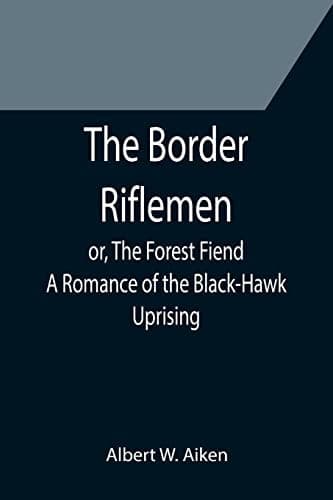
The Border Riflemen; or, The Forest Fiend. A Romance of the Black-Hawk UprisingAiken, Albert W.
General
The Border Riflemen; or, The Forest Fiend. A Romance of the Black-Hawk Uprising
Aiken, Albert W.
Black Hawk War, 1832 -- Fiction; Dime novels
The door opened suddenly, and a young girl holding a water-pail in her
hand came out with a free, careless step, singing a merry song. She was
plainly dressed, and yet there was an air of native grace about her
every movement which plainly showed that she had not always lived amid
such wild surroundings. She was beautiful—not the vapid beauty of
cities, but that of perfect health, and a free life. Her form was
untrammeled by the fashions which cramp and deform the beautiful women
of our day, and her face, a little browned by exposure to the to sun,
glowed—
“With sunny beauty and rustic health.”
Maud Müller—Whittier’s Maud—was not more beautiful than this frontier
damsel. Not only was her face cut in a perfect mold, but her eyes
sparkled with life and vivacity, and her sunny hair, unconfined, hung
about her shoulders in beautiful profusion.
She left the river, turned down the creek, entered a little grove half a
mile from the house, passed through it, and looked across the open field
beyond.
“Father,” she cried, “are you there?”
No answer was returned, save the echo of her musical voice, and she
looked about her in evident surprise.
“Where can he have gone?” she murmured. “Father!”
As the words left her lips there was a slight rustle in the bushes by
her side, and a man came out and stood beside her. He was still young,
but his strikingly handsome face bore the marks of a life of dissipation
and riot. He was quite tall, nearly six feet in his moccasins, with a
face which showed unmistakable signs of Indian blood, though somewhat
remote, and a wandering black eye, full of passion. He was dressed in
hunting costume, and held in one hand a long rifle, and two small
protuberances in the breast of his hunting-coat showed where his pistols
lay concealed.
“I thought I should meet you here, Sadie,” he said, quietly. “You don’t
look very glad to see me.”
“You know what I think of you, William Jackwood,” she replied, turning
quickly away. “How dare you to come here, after what has happened?”
He laughed a low, bitter, chilling laugh, which did not indicate
enjoyment, and his black eyes seemed to emit sparks of fire.
“I would not refer to our last meeting, if I were you, Sadie,” he said,
evidently controlling himself by a violent effort. “I was half crazy
with liquor that night or I would not have said what I did. See here;
give me a chance to make this right with you and I’ll do it. I want to
be a friend to you—I do, upon my soul. I’ll ask your pardon on my knees,
if you’ll forgive, and promise not to lay it up against me.”
“I forgive you,” she said, with a cold, passionless glance, “but you
must not come here any more, for all that. My father has told me not to
have any more to say to you, and I shall obey him.”
The man stood grinding the butt of his rifle into the soft earth, and
fighting a powerful battle to keep down his heart. The girl no longer
looked at him but took up the pail and was moving on.
Public-domain text, read in full here on John Shaqi.
Reviews
Reviews
No reviews yet
Be the first to share your thoughts on this work.
Join the Discussion
Join the discussion
Sign in to leave a comment or review.
Sign InorCreate an account