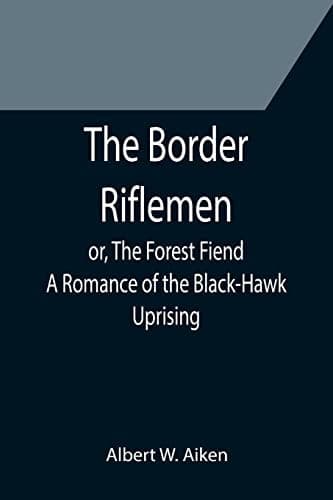
The Border Riflemen; or, The Forest Fiend. A Romance of the Black-Hawk Uprising — John Shaqi
The Border Riflemen; or, The Forest Fiend. A Romance of the Black-Hawk UprisingAiken, Albert W.
General
The Border Riflemen; or, The Forest Fiend. A Romance of the Black-Hawk Uprising
Aiken, Albert W.
Black Hawk War, 1832 -- Fiction; Dime novels
Napope waved his hand, and, as if by magic, every warrior disappeared,
and a stillness like that of death fell upon the scene. The whites came
in rapidly, unsuspicious of danger, and passed through the first bushes,
when they were surprised to hear a sudden crash and a yell of surprise
and anger. The crash came from Tom Bantry, who had managed to fall down
with a great noise, at the same time giving the yell which startled the
white rangers.
“Tree, boys!” yelled Cooney Joe. “Tree and fight. Injins thar, by the
big horn spoon.”
The men who followed Cooney Joe were Indian-fighters of the first class,
and the order had scarcely been given when every man was sheltered by a
tree and had his rifle ready for action. This was not done a moment too
soon, for the feathers of the savages began to show above the bushes,
and several shots were fired, until a commanding voice shouted to the
warriors to hold their fire.
“What do the white men seek?” cried Napope. “They have been beaten once;
must we beat them again?”
“That’s Napope,” cried Cooney Joe. “I know the old cuss, and he kin
fight, if he is an Injin; but we’ll lick him out of his moccasins. Say,
Injin, you’d better clear the way; you ain’t got the major to fight
now.”
“Napope does not seek the scalps of the white men,” cried the Indian.
“If they bring the scalps to him, he will take them, but he does not
thirst for blood. Let Captain Melton turn back and cross the river.”
“The path must be clear for me to pass through,” replied Melton. “The
hatchet has been dug up and its edge turned against women and children,
and the good white man, Wescott, with his daughter, has been carried
away, and we think the Sacs know where they are.”
“The Sacs do not know,” replied Napope, proudly. “Does the white man
take us for Menomonies or Chippewas? The Sacs are men and not dogs; they
do not fight against women and children.”
“Napope is a brave man, and will not lie to save his life,” said Melton.
“Let us pass on safely, and then there shall be no blood shed, for we
seek only those who have stolen the brave man Wescott and his child.”
“My brother must turn back,” replied the chief. “There is no path over
the Indian country for white soldiers until peace is made; but if the
good white man and his child are here, they shall be made welcome, and
no harm shall come to them if Napope can give them aid. But Melton must
take his warriors and go back to his people.”
“We will not turn back,” replied Melton, angrily, “unless we take the
friends we seek with us. Let Napope clear the way, or we will try to go
on without his leave.”
“The white men will find knives and hatchets in the path,” replied the
chief, grimly. “Go back as you came, and all shall be well; refuse, and
you shall find that my young men carry guns.”
Public-domain text, read in full here on John Shaqi.
Reviews
Reviews
No reviews yet
Be the first to share your thoughts on this work.
Join the Discussion
Join the discussion
Sign in to leave a comment or review.
Sign InorCreate an account