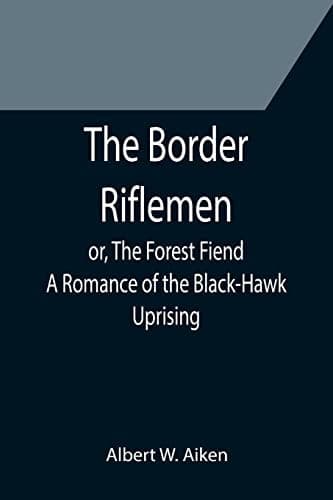
The Border Riflemen; or, The Forest Fiend. A Romance of the Black-Hawk Uprising — John Shaqi
The Border Riflemen; or, The Forest Fiend. A Romance of the Black-Hawk UprisingAiken, Albert W.
General
The Border Riflemen; or, The Forest Fiend. A Romance of the Black-Hawk Uprising
Aiken, Albert W.
Black Hawk War, 1832 -- Fiction; Dime novels
When the enemy had been so scattered as to leave the path free, the
small band of rangers plunged deeper into the woods and kept on their
course until they reached a small wooded swamp through which many small
creeks ran, leaving a little island in the center, containing, perhaps,
two acres of land. The tall trees stood thick about it, and no better
place of defense could possibly have been selected. No sooner had they
reached the island than they set to work fortifying it by piling up
fallen logs into a temporary barricade, making it strongest upon the
only point which could be assailed by land, as the creeks swept around
it on three sides, leaving a space of smooth ground about twenty feet
wide. Across this they built a strong barricade at least ten feet high,
through the openings of which, they could fire upon the foe, without
being themselves seen.
The other parts of the island were almost impervious to assault, for not
only did the deep creek guard it, but the logs had fallen all about it
in inextricable confusion, making a _chevaux de frise_ through which a
corps of axmen would have found it extremely difficult to force their
way. The middle of the island was cleared, leaving the path open for
them to pass from one part to another, and they now waited almost
eagerly for the coming of the enemy, who, as yet, did not appear. Cooney
Joe took his rifle and stole out toward the clearing, and for half an
hour the “scout” remained quiet, waiting in considerable anxiety for the
coming of the hunter, whose danger they well knew. But he came back at a
long-loping trot, his rifle at a trail, and his eyes flashing with the
ardor of battle.
“Git ready, boys,” he cried. “We’ve got business afore us, bet yer
life.”
“What now, Joe?” demanded the captain. “Who are coming?”
“All that’s left of Napope’s band and thirty of Dick Garrett’s men,”
replied Joe. “And—”
“Thar’s an Injin,” cried one of the men. “I’ll pop him over.”
“Hold on,” replied Joe. “Seems to me that chap is making signals that
look _white_. Thar; look at that!”
An Indian had appeared in plain sight and was waving a white cloth in
the air.
“Hello, _you_!” yelled Joe. “Come in, ef you want to.”
The man obeyed and came clambering over the barricade, and at a glance
they could see that he was a white man disguised. It was Tom Bantry, who
had escaped from associates with whom he could no longer consort.
“Look here, men,” he said. “I’m Tom Bantry. You don’t know _me_ and
mebbe you don’t want to. I’ve been one of Dick Garrett and Will
Jackwood’s men—I have. Now why don’t you kill me?”
“Don’t see my way to that clear,” said Joe. “Now, Tom Bantry, what d’ye
want here?”
“I’ve, quit ’em,” replied Tom, energetically. “I couldn’t stand it,
boys, ’pon my word, I couldn’t. I feel mean as dirt ’cause I’ve been
with ’em so long; but I tell you I didn’t think they was so mean till
last night when they killed poor Mr. Wescott.”
Public-domain text, read in full here on John Shaqi.
Reviews
Reviews
No reviews yet
Be the first to share your thoughts on this work.
Join the Discussion
Join the discussion
Sign in to leave a comment or review.
Sign InorCreate an account