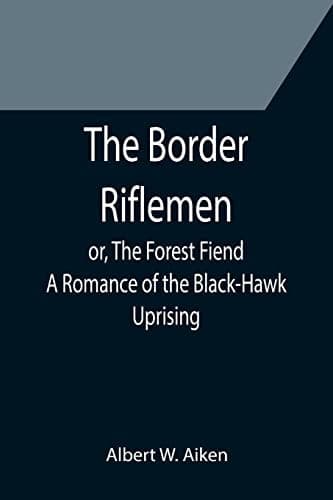
The Border Riflemen; or, The Forest Fiend. A Romance of the Black-Hawk UprisingAiken, Albert W.
General
The Border Riflemen; or, The Forest Fiend. A Romance of the Black-Hawk Uprising
Aiken, Albert W.
Black Hawk War, 1832 -- Fiction; Dime novels
“Who asked you to speak, Joe Bent?” said Black Will, savagely. “Keep
your distance and live in safety for twenty-four hours, but after that I
will take your life, no matter where I meet you.”
“You rare ’round the awfulest kind, don’t ye,” replied Joe, with a merry
look. “Dash my bacon ef you ain’t a study fur a painter. I’ve see’d
chaps in the theater at St. Louis that rared ’round the stage jest as
you do now, but somehow they allus got special hail kolumbia in the end.
Now _git_; I don’t want to say any thing more _but_ git.”
Black Will quietly tightened his belt, brought his rifle to a “right
shoulder shift,” and was off at a long, slinging pace which carried him
rapidly across the field.
“Thar goes a pizen critter, Miss Sadie,” muttered Cooney Joe. “Now I
reckon he meant jest what he said when he told me that he’d hev my life,
but I’ve took a good many chances, though he’ll hev my ha’r sartin ef I
don’t shoot first when we meet.”
“I am sorry to have brought you into danger, Joe,” said the girl.
“Sorry—danger—git out! D’ye think I keer fur _that_, little gal? Why,
make it the wust ye kin, the chances ar’ I git a shot afore he does, an’
ef I _miss_, then it’s my own fault. Whar’s yer daddy?”
“I came out to find him and bring him some drink. I thought he was at
work in this field.”
“He orter be keerful,” said Joe Bent, uneasily, “’cause the Injins are
gitting r’iled up awful, and thar’s no tellin’ when they may break out.
Let’s try an’ find him.”
“There he is now,” cried Sadie.
As she spoke, a middle-aged man, with a hoe across his shoulder,
appeared at the other side of the woods and came rapidly toward them. As
he came near he shouted cheerily to Joe Bent, who seemed very glad to
see him, and they shook hands heartily. Mr. Wescott had the same air of
gentility which showed itself in his daughter, but, like her, had
adapted himself to his present surroundings, and looked the picture of a
genuine western farmer. In stature he was almost a giant.
Sadie rapidly recounted her meeting with Black Will, and all that had
passed between them, and the face of Mr. Wescott darkened, while his
hand closed convulsively upon the handle of his hoe.
“It is a lucky thing for the black-hearted scoundrel that I was not by,
Sadie,” he said, “or it would have gone hard with him. What brings you
up this way, Joe?”
“I sort o’ got a hint to git off the hunting grounds from that
pernicious red devil, Napope, who is sp’ilin’ fur mischief. Ar’ ye good
friends with the Injins, ’square?”
“Certainly; I never wronged one of them in my life.”
“Not that it matters much ef they once rise,” continued Joe, “because
then they won’t hev any friends in the white race. I’ve my doubts of
that Black Will, anyhow. Two weeks ago I saw him in the Injin village,
an’ him an’ that cussid Napope was ez thick ez flies in sp’iled bacon.”
“What is the trouble with the Indians?” said Wescott, uneasily.
Public-domain text, read in full here on John Shaqi.
Reviews
Reviews
No reviews yet
Be the first to share your thoughts on this work.
Join the Discussion
Join the discussion
Sign in to leave a comment or review.
Sign InorCreate an account