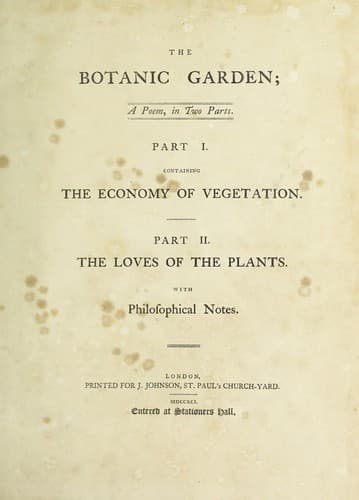
The Botanic Garden. Part 2, Containing the Loves of the Plants. A Poem.: With Philosophical Notes.Darwin, Erasmus
History
The Botanic Garden. Part 2, Containing the Loves of the Plants. A Poem.: With Philosophical Notes.
Darwin, Erasmus
Natural history; Plants -- Poetry
[_Muschus_. l. 353. Corallinus, or lichen rangiferinus. Coral-moss.
Clandestine-marriage. This moss vegetates beneath the snow, where the
degree of heat is always about 40; that is, in the middle between the
freezing point, and the common heat of the earth; and is for many months
of the winter the sole food of the rain-deer, who digs furrows in the
snow to find it: and as the milk and flesh of this animal is almost the
only sustenance which can be procured during the long winters of the
higher latitudes, this moss may be said to support some millions of
mankind.
The quick vegetation that occurs on the solution of the snows in high
latitudes appears very astonishing; it seems to arise from two causes,
1. the long continuance of the approaching sun above the horizon; 2. the
increased irritability of plants which have been long exposed to the
cold. See note on Anemone.
All the water-fowl on the lakes of Siberia are said by Professor Gmelin
to retreat Southwards on the commencement of the frosts, except the Rail,
which sleeps buried in the snow. Account of Siberia.]
Night's tinsel beams on smooth Lock-lomond dance,
Impatient ÆGA views the bright expanse;--
365 In vain her eyes the parting floods explore,
Wave after wave rolls freightless to the shore.
--Now dim amid the distant foam she spies
A rising speck,--"'tis he! 'tis he!" She cries;
As with firm arms he beats the streams aside,
370 And cleaves with rising chest the tossing tide,
With bended knee she prints the humid sands,
Up-turns her glistening eyes, and spreads her hands;
--"'Tis he, 'tis he!--My Lord, my life, my love!--
Slumber, ye winds; ye billows, cease to move!
375 beneath his arms your buoyant plumage spread,
Ye Swans! ye Halcyons! hover round his head!"--
[_Æga_ l. 364. Conserva ægagropila. It is found loose in many lakes
in a globular form, from the size of a walnut to that of a melon, much
resembling the balls of hair found in the stomachs of cows; it adheres
to nothing, but rolls from one part of the lake to another. The Conserva
vagabunda dwells on the European seas, travelling along in the midst of
the waves; (Spec. Plant.) These may not improperly be called itinerant
vegetables. In a similar manner the Fucus natans (swimming) strikes no
roots into the earth, but floats on the sea in very extensive masses, and
may be said to be a plant of passage, as it is wafted by the winds from
one shore to another.]
--With eager step the boiling surf she braves,
And meets her refluent lover in the waves;
Loose o'er the flood her azure mantle swims,
380 And the clear stream betrays her snowy limbs.
Public-domain text, read in full here on John Shaqi.
Reviews
Reviews
No reviews yet
Be the first to share your thoughts on this work.
Elsewhere in the archive
Join the Discussion
Join the discussion
Sign in to leave a comment or review.
Sign InorCreate an account