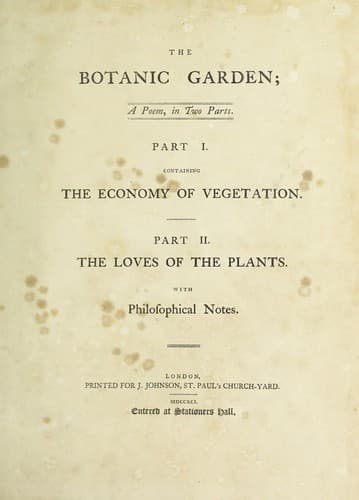
The Botanic Garden. Part 2, Containing the Loves of the Plants. A Poem.: With Philosophical Notes.Darwin, Erasmus
History
The Botanic Garden. Part 2, Containing the Loves of the Plants. A Poem.: With Philosophical Notes.
Darwin, Erasmus
Natural history; Plants -- Poetry
So on her sea-girt tower fair HERO stood
At parting day, and mark'd the dashing flood;
While high in air, the glimmering rocks above,
Shone the bright lamp, the pilot-star of Love.
385 --With robe outspread the wavering flame behind
She kneels, and guards it from the shifting wind;
Breathes to her Goddess all her vows, and guides
Her bold LEANDER o'er the dusky tides;
Wrings his wet hair, his briny bosom warms,
390 And clasps her panting lover in her arms.
Deep, in wide caverns and their shadowy ailes,
Daughter of Earth, the chaste TRUFFELIA smiles;
[_Truffelia_. l. 392. (Lycoperdon Tuber) Truffle. Clandestine marriage.
This fungus never appears above ground, requiring little air, and perhaps
no light. It is found by dogs or swine, who hunt it by the smell. Other
plants, which have no buds or branches on their stems, as the grasses,
shoot out numerous stoles or scions underground; and this the more,
as their tops or herbs are eaten by cattle, and thus preserve
themselves,]
On silvery beds, of soft asbestus wove,
Meets her Gnome-husband, and avows her love.
395 --_High_ o'er her couch impending diamonds blaze,
And branching gold the crystal roof inlays;
With verdant light the modest emeralds glow,
Blue sapphires glare, and rubies blush, _below_;
Light piers of lazuli the dome surround,
400 And pictured mochoes tesselate the ground;
In glittering threads along reflective walls
The warm rill murmuring twinkles, as it falls;
Now sink the Eolian strings, and now they swell,
And Echoes woo in every vaulted cell;
405 While on white wings delighted Cupids play,
Shake their bright lamps, and shed celestial day.
Closed in an azure fig by fairy spells,
Bosom'd in down, fair CAPRI-FICA dwells;--
[_Caprificus_. l. 408 Wild fig. The fruit of the fig is not a
seed-vessel, but a receptacle inclosing the flower within it. As these
trees bear some male and others female flowers, immured on all sides by
the fruit, the manner of their fecundation was very unintelligible, till
Tournefort and Pontedera discovered, that a kind of gnat produced in the
male figs carried the fecundating dust on its wings, (Cynips Psenes
Syst. Nat. 919.), and, penetrating the female fig, thus impregnated
the flowers; for the evidence of this wonderful fact, see the word
Caprification, in Milne's Botanical Dictionary. The figs of this country
are all female, and their seeds not prolific; and therefore they can only
be propagated by layers and suckers.
Public-domain text, read in full here on John Shaqi.
Reviews
Reviews
No reviews yet
Be the first to share your thoughts on this work.
Elsewhere in the archive
Join the Discussion
Join the discussion
Sign in to leave a comment or review.
Sign InorCreate an account