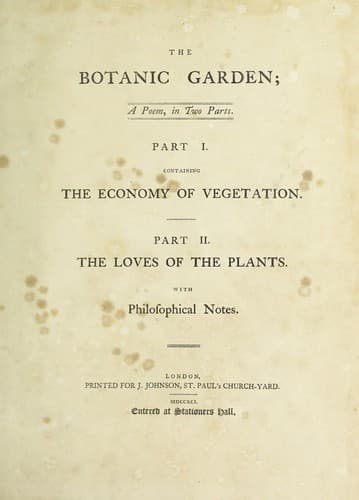
The Botanic Garden. Part 2, Containing the Loves of the Plants. A Poem.: With Philosophical Notes.Darwin, Erasmus
History
The Botanic Garden. Part 2, Containing the Loves of the Plants. A Poem.: With Philosophical Notes.
Darwin, Erasmus
Natural history; Plants -- Poetry
Monsieur de la Hire has shewn in the Memoir, de l'Academ. de Science,
that the summer figs of Paris, in Provence, Italy, and Malta, have all
perfect stamina, and ripen not only their fruits, but their seed; from
which seed other fig-trees are raised; but that the stamina of the
autumnal figs are abortive, perhaps owing to the want of due warmth. Mr.
Milne, in his Botanical Dictionary (art. Caprification), says, that the
cultivated fig-trees have a few male flowers placed above the female
within the same covering or receptacle; which in warmer climates perform
their proper office, but in colder ones become abortive: And Linneus
observes, that some figs have the navel of the receptacle open; which
was one reason that induced him to remove this plant from the class
Clandestine Marriage to the class Polygamy. Lin. Spec. Plant.
From all these circumstances I should conjecture, that those female
fig-flowers, which are closed on all sides in the fruit or receptacle
without any male ones, are monsters, which have been propagated for their
fruit, like barberries, and grapes without seeds in them; and that the
Caprification is either an ancient process of imaginary use, and blindly
followed in some countries, or that it may contribute to ripen the fig
by decreasing its vigour, like cutting off a circle of the bark from the
branch of a pear-tree. Tournefort seems inclined to this opinion; who
says, that the figs in Provence and at Paris ripen sooner, if their buds
be pricked with a straw dipped in olive-oil. Plumbs and pears punctured
by some insects ripen sooner, and the part round the puncture is sweeter.
Is not the honey-dew produced by the puncture of insects? will not
wounding the branch of a pear-tree, which is too vigorous, prevent the
blossoms from falling off; as from some fig-trees the fruit is said to
fall off unless they are wounded by caprification? I had last spring six
young trees of the Ischia fig with fruit on them in pots in a stove; on
removing them into larger boxes, they protruded very vigorous shoots, and
the figs all fell off; which I ascribed to the increased vigour of the
plants.]
Public-domain text, read in full here on John Shaqi.
Reviews
Reviews
No reviews yet
Be the first to share your thoughts on this work.
Elsewhere in the archive
Join the Discussion
Join the discussion
Sign in to leave a comment or review.
Sign InorCreate an account