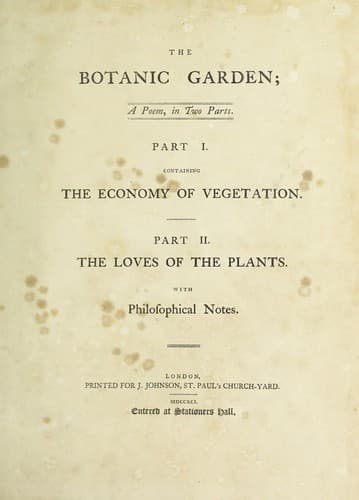
The Botanic Garden. Part 2, Containing the Loves of the Plants. A Poem.: With Philosophical Notes.Darwin, Erasmus
History
The Botanic Garden. Part 2, Containing the Loves of the Plants. A Poem.: With Philosophical Notes.
Darwin, Erasmus
Natural history; Plants -- Poetry
[_Osyris_. l. 75. Two houses. The males and females are on different
plants. There are many instances on record, where female plants have been
impregnated at very great distance from their male; the dust discharged
from the anthers is very light, small, and copious, so that it may spread
very wide in the atmosphere, and be carried to the distant pistils,
without the supposition of any particular attraction; these plants
resemble some insects, as the ants, and cochineal insect, of which the
males have wings, but not the female.]
With strange deformity PLANTAGO treads,
A Monster-birth! and lifts his hundred heads;
Yet with soft love a gentle belle he charms,
80 And clasps the beauty in his hundred arms.
So hapless DESDEMONA, fair and young,
Won by OTHELLO'S captivating tongue,
Sigh'd o'er each strange and piteous tale, distress'd,
And sunk enamour'd on his sooty breast.
85 _Two_ gentle shepherds and their sister-wives
With thee, ANTHOXA! lead ambrosial lives;
[_Plantago_. l. 77. Rosea. Rose Plantain. In this vegetable monster the
bractes, or divisions of the spike, become wonderfully enlarged; and are
converted into leaves. The chaffy scales of the calyx in Xeranthemum, and
in a species of Dianthus, and the glume in some alpine grasses, and the
scales of the ament in the salix rosea, rose willow, grow into leaves;
and produce other kinds of monsters. The double flowers become monsters
by the multiplication of their petals or nectaries. See note on Alcea.
[_Anthoxanthum_. l. 83. Vernal grass. Two males, two females. The other
grasses have three males and two females. The flowers of this grass give
the fragrant scent to hay. I am informed it is frequently viviparous,
that is, that it bears sometimes roots or bulbs instead of seeds, which
after a time drop off and strike root into the ground. This circumstance
is said to obtain in many of the alpine grasses, whose seeds are
perpetually devoured by small birds. The Festuca Dometorum, fescue grass
of the bushes, produces bulbs from the sheaths of its straw. The Allium
Magicum, or magical onion, produces onions on its head, instead of seeds.
The Polygonum Viviparum, viviparous bistort, rises about a foot high,
with a beautiful spike of flowers, which are succeeded by buds or bulbs,
which fall off and take root. There is a bulb, frequently seen on
birch-trees, like a bird's nest, which seems to be a similar attempt of
nature, to produce another tree; which falling off might take root in
spongy ground.
There is an instance of this double mode of production in the animal
kingdom, which is equally extraordinary: the same species of Aphis is
viviparous in summer, and oviparous in autumn. A. T. Bladh. Amoen. Acad.
V. 7.]
Public-domain text, read in full here on John Shaqi.
Reviews
Reviews
No reviews yet
Be the first to share your thoughts on this work.
Join the Discussion
Join the discussion
Sign in to leave a comment or review.
Sign InorCreate an account