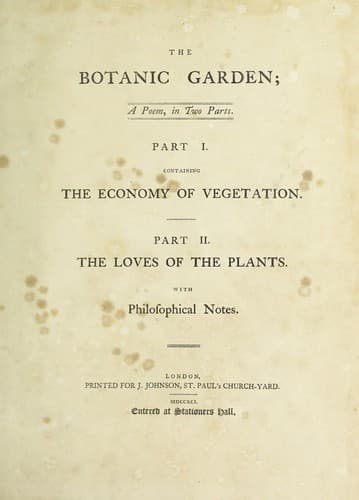
The Botanic Garden. Part 2, Containing the Loves of the Plants. A Poem.: With Philosophical Notes.Darwin, Erasmus
History
The Botanic Garden. Part 2, Containing the Loves of the Plants. A Poem.: With Philosophical Notes.
Darwin, Erasmus
Natural history; Plants -- Poetry
P. 15. _Addition to the note on Silene._ I saw a plant of the Dionaea
Muscipula, Flytrap of Venus, this day, in the collection of Mr. Boothby
at Ashbourn-Hall, Derbyshire, Aug. 20th, 1788; and on drawing a straw
along the middle of the rib of the leaves as they lay upon the ground
round the stem, each of them, in about a second of time, closed and
doubled itself up, crossing the thorns over the opposite edge of the
leaf, like the teeth of a spring rap-trap: of this plant I was favoured
with an elegant coloured drawing, by Miss Maria Jackson of Tarporly, in
Cheshire, a Lady who adds much botanical knowledge to many other elegant
acquirements. In the Apocynum Androsaemifolium, one kind of Dog's bane,
the anthers converge over the nectaries, which consist of five glandular
oval corpuscles surrounding the germ; and at the same time admit air
to the nectaries at the interstice between each anther. But when a fly
inserts its proboscis between these anthers to plunder the honey, they
converge closer, and with such violence as to detain the fly, which thus
generally perishes. This account was related to me by R.W. Darwin, Esq;
of Elston, in Nottinghamshire, who showed me the plant in flower, July
2d, 1788, with a fly thus held fast by the end of its proboscis, and was
well seen by a magnifying lens, and which in vain repeatedly struggled to
disengage itself, till the converging anthers were separated by means
of a pin: on some days he had observed that almost every flower of this
elegant plant had a fly in it thus entangled; and a few weeks afterwards
favoured me with his further observations on this subject.
"My Apocynum is not yet out of flower. I have often visited it, and
have frequently found four or five flies, some alive, and some dead,
in its flowers; they are generally caught by the trunk or proboscis,
sometimes by the trunk and a leg; there is one at present only caught
by a leg: I don't know that this plant sleeps, as the flowers remain
open in the night; yet the flies frequently make their escape. In a
plant of Mr. Ordino's, an ingenious gardener at Newark, who is
possessed of a great collection of plants, I saw many flowers of an
Apocynum with three dead flies in each; they are a thin-bodied fly, and
rather less than the common house-fly; but I have seen two or three
other sorts of flies thus arrested by the plant. Aug. 12, 1788."
P. 18. _Additional note on Ilex_. The efficient cause which renders the
hollies prickly in Needwood Forest only as high as the animals can reach
them, may arise from the lower branches being constantly cropped by them,
and thus shoot forth more luxuriant foliage: it is probable the shears in
garden-hollies may produce the same effect, which is equally curious, as
prickles are not thus produced on other plants.
Public-domain text, read in full here on John Shaqi.
Reviews
Reviews
No reviews yet
Be the first to share your thoughts on this work.
Elsewhere in the archive
Join the Discussion
Join the discussion
Sign in to leave a comment or review.
Sign InorCreate an account