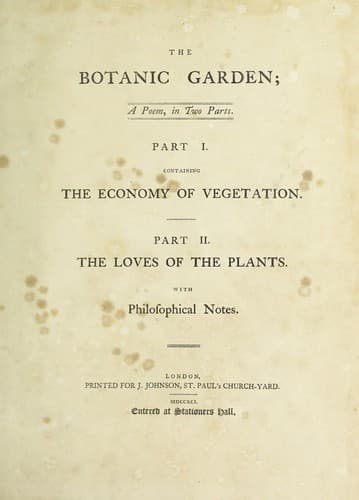
The Botanic Garden. Part 2, Containing the Loves of the Plants. A Poem.: With Philosophical Notes.Darwin, Erasmus
History
The Botanic Garden. Part 2, Containing the Loves of the Plants. A Poem.: With Philosophical Notes.
Darwin, Erasmus
Natural history; Plants -- Poetry
P. 41. _Additional note on Ulva_. M. Hubert made some observations on the
air contained in the cavities of the bambou. The stems of these canes
were from 40 to 50 feet in height, and 4 or 5 inches in diameter, and
might contain about 30 pints of elastic air. He cut a bambou, and
introduced a lighted candle into the cavity, which was extinguished
immediately on its entrance. He tried this about 60 times in a cavity of
the bambou, containing about two pints. He introduced mice at different
times into these cavities, which seemed to be somewhat affected, but soon
recovered their agility. The stem of the bambou is not hollow till it
rises more than one foot from the earth; the divisions between the
cavities are convex downwards. Observ. sur la Physique par M. Rozier,
l. 33. p. 130.
P. 65. _Additional note on Gossypium_.
--------emerging Naïads cull
From leathery pods the vegetable wool.
----_eam circum Milesia vellera nymphæ
Carpebant, hyali saturo fucata colore_.
Virg. Georg. IV. 334.
P. 119. _Addition to Orchis_. The two following lines were by mistake
omitted; they were to have been inserted after l. 282, p. 119.
Saw on his helm, her virgin hands inwove,
Bright stars of gold, and mystic knots of love;
P. 136. _Addition to the note on Tropæolum_. In Sweden a very curious
phenomenon has been observed on certain flowers, by M. Haggren,
Lecturer in Natural History. One evening be perceived a faint flash of
light repeatedly dart from a Marigold; surprized at such an uncommon
appearance, he resolved to examine it with attention; and, to be assured
that it was no deception of the eye, he placed a man near him, with
orders to make a signal at the moment when he observed the light. They
both saw it constantly at the same moment.
The light was most brilliant on Marigolds, of an orange or flame colour;
but scarcely visible on pale ones.
The flash was frequently seen on the same flower two or three times in
quick succession, but more commonly at intervals of several minutes; and
when several flowers in the same place emitted their light together, it
could be observed at a considerable distance.
This phaenomenon was remarked in the months of July and August, at
sun-set, and for half an hour after, when the atmosphere was clear; but
after a rainy day, or when the air was loaded with vapours, nothing of it
was seen.
The following flowers emitted flashes, more or less vivid, in this
order:
1. The Marigold, _(Calendula Officinalis)_.
2. Garden Nasturtion, _(Tropæolum majus)_.
3. Orange Lily, _(Lilium bulbiferum)_.
4. The Indian Pink, _(Tagetes patula et erecta)_.
Sometimes it was also observed on the Sun-flowers, _(Helianthus annuus)_.
But bright yellow, or flame colour, seemed in general necessary for the
production of this light; for it was never seen on the flowers of any
other colour.
Public-domain text, read in full here on John Shaqi.
Reviews
Reviews
No reviews yet
Be the first to share your thoughts on this work.
Elsewhere in the archive
Join the Discussion
Join the discussion
Sign in to leave a comment or review.
Sign InorCreate an account