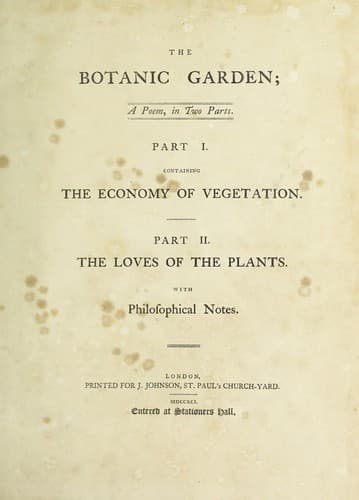
The Botanic Garden. Part 2, Containing the Loves of the Plants. A Poem.: With Philosophical Notes.Darwin, Erasmus
History
The Botanic Garden. Part 2, Containing the Loves of the Plants. A Poem.: With Philosophical Notes.
Darwin, Erasmus
Natural history; Plants -- Poetry
To discover whether some little insects, or phosphoric worms, might not
be the cause of it, the flowers were carefully examined even with a
microscope, without any such being found.
From the rapidity of the flash, and other circumstances, it might be
conjectured, that there is something of electricity in this phaenomenon.
It is well known, that when the _pistil_ of a flower is impregnated, the
_pollen_ bursts away by its elasticity, with which electricity may be
combined. But M. Haggren, after having observed the slash from the
Orange-lily, the _anthers_ of which are a considerable space distant from
the _petals,_ found that the light proceeded from the _petals_ only;
whence he concludes, that this electric light is caused by the _pollen_,
which in flying off is scattered upon the _petals._ Obser. Physìque par
M. Rozier, Vol. XXXIII. p. iii.
P. 153. _Addition to Avena._ The following lines were by mistake omitted;
they were designed to have been inserted after l. 102, p. 153.
Green swells the beech, the widening knots improve,
So spread the tender growths of culture'd love;
Wave follows wave, the letter'd lines decay,
So Love's soft forms neglected melt away.
P. 157. _Additional note to Bellis._ Du Halde gives an account of a white
wax made by small insects round the branches of a tree in China in great
quantity, which is there collected for economical and medical purposes:
the tree is called Tong-tsin. Description of China, Vol. I. p. 230.
_Description of the Poison-Tree in the Island of JAVA. Translated from
the original Dutch of_ N. P. Foerich.
This destructive tree is called in the Malayan language _Bohon-Upas,_
and has been described by naturalists; but their accounts have been
so tinctured with the _marvellous,_ that the whole narration has been
supposed to be an ingenious fiction by the generality of readers. Nor
is this in the least degree surprising, when the circumstances which we
shall faithfully relate in this description are considered.
Public-domain text, read in full here on John Shaqi.
Reviews
Reviews
No reviews yet
Be the first to share your thoughts on this work.
Elsewhere in the archive
Join the Discussion
Join the discussion
Sign in to leave a comment or review.
Sign InorCreate an account