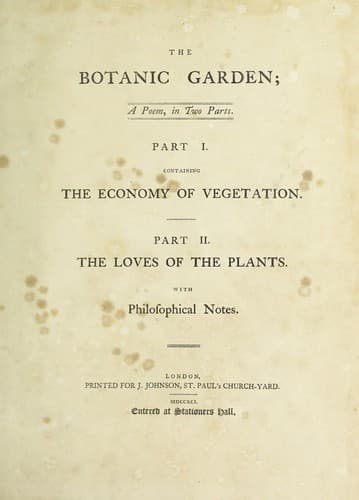
The Botanic Garden. Part 2, Containing the Loves of the Plants. A Poem.: With Philosophical Notes.Darwin, Erasmus
History
The Botanic Garden. Part 2, Containing the Loves of the Plants. A Poem.: With Philosophical Notes.
Darwin, Erasmus
Natural history; Plants -- Poetry
Tartarian lamb; use of down on vegetables; air, glass, wax, and fat, are
bad conductors of heat; snow does not moisten the living animals buried
in it, illustrated by burning camphor in snow
Of the collapse of the sensitive plant
Birds of passage
The acquired habits of plants
Irritability of plants increased by previous exposure to cold
Lichen produces the first vegetation on rocks
Plants holding water
Madder colours the bones of young animals
Colours of animals serve to conceal them
Warm bathing retards old age
Male flowers of Vallisneria detach themselves from the plant, and float
to the female ones
Air in the cells of plants, its various uses
How Mr. Day probably lost his life in his diving-ship
Air-bladders of fish
Star-gelly is voided by Herons
Intoxicating mushrooms
Mushrooms grow without light, and approach to animal nature
Seeds of Tillandsia fly on long threads, like spiders on the gossamer
Account of cotton mills
Invention of letters, figures, crotchets
Mrs. Delany's and Mrs. North's paper-gardens
The horologe of Flora
The white petals of Helleborus niger become first red, and then change
into a green calyx
Berries of Menispernum intoxicate fish
Effects of opium
Frontispiece by Miss Crewe
Petals of Cistus and Oenanthe continue but a few hours
Method of collecting the gum from Cistus by leathern throngs
Discovery of the Bark
Foxglove how used in Dropsies
Bishop of Marseilles, and Lord Mayor of London
Superstitious uses of plants, the divining rod, animal magnetism
Intoxication of the Pythian Priestess, poison from Laurel-leaves, and
from cherry-kernels
Sleep consists in the abolition of voluntary power; nightmare explained
Indian fig emits slender cords from its summit
Cave of Thor in Derbyshire, and sub-terraneous rivers explained
The capsule of the Geranium makes a hygrometer; Barley creeps out of a
barn Mr. Edgeworth's creeping hygrometer
Flower of Fraxinella flashes on the approach of a candle
Essential oils narcotic, poisonous, deleterious to insects
Dew-drops from Mancinella blister the skin
Uses of poisonous juices in the vegetable economy
The fragrance of plants a part of their defence
The sting and poison of a nettle
Vapour from Lobelia suffocative; unwholesomness of perfumed hair-powder
Ruins of Palmira
The poison-tree of Java
Tulip roots die annually
Hyacinth and Ranunculus roots
Vegetable contest for air and light
Some voluble stems turn E.S.W. and others W.S.E.
Tops of white Bryony as grateful as asparagus
Fermentation converts sugar into spirit, food into poison
Fable of Prometheus applied to dram-drinkers
Cyclamen buries its seeds and trifolium subterraneum
Pits dug to receive the dead in the plague
Lakes of America consist of fresh water
The seeds of Cassia and some others are carried from America, and thrown
on the coasts of Norway and Scotland
Of the gulf-stream
Wonderful change predicted in the gulph of Mexico
Public-domain text, read in full here on John Shaqi.
Reviews
Reviews
No reviews yet
Be the first to share your thoughts on this work.
Elsewhere in the archive
Join the Discussion
Join the discussion
Sign in to leave a comment or review.
Sign InorCreate an account