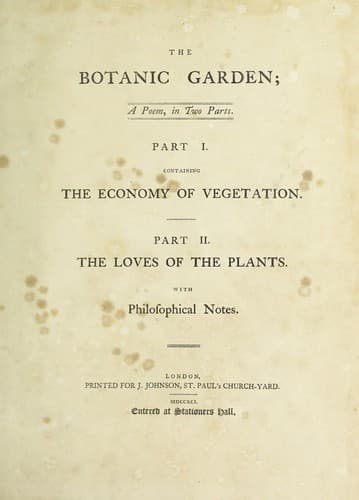
The Botanic Garden. Part 2, Containing the Loves of the Plants. A Poem.: With Philosophical Notes.Darwin, Erasmus
History
The Botanic Garden. Part 2, Containing the Loves of the Plants. A Poem.: With Philosophical Notes.
Darwin, Erasmus
Natural history; Plants -- Poetry
In the flowers of Cactus grandiflorus and Cistus some of the stamens are
perpetually bent to the pistil
Nyctanthes and others are only fragrant in the night; Cucurbita lagenaria
closes when the sun shines on it
Tropeolum, nasturtian, emits sparks in the twilight
Nectary on its calyx
Phosphorescent lights in the evening
Hot embers eaten by bull-frogs
Long filaments of grasses, the cause of bad seed-wheat
Chinese hemp grew in England above 14 feet in five months
Roots of snow-drop and hyacinth insipid like orchis
Orchis will ripen its seeds if the new bulb be cut off
Proliferous flowers
The wax on the candle-berry myrtle said to be made by insects
The warm springs of matlock produced by the condensation of steam raised
from great depths by subterranean fires
Air separated from water by the attraction of points to water being less
than that of the particles of water to each other
Minute division of sub-aquatic leaves
Water-cress and other aquatic plants inhabit all climates
Butomus esculent; Lotus of Egypt; Nymphæa
Ocymum covered with salt every night
Salt a remote cause of scrophula, and immediate cause of sea-scurvy
Coloured spatha of Arum, and blotched leaves, if they serve the purpose
of a coloured petal
Tulip-roots with a red cuticle produce red flowers
Of vegetable mules the internal parts, at those of fructification,
resemble the female parent; and the external parts, the male one
The same occurs in animal mules, as the common mule and the hinnus, and
in sheep
The wind called Harmattan from volcanic eruptions; some epidemic coughs
or influenza have the same origin
Fish killed in the sea by dry summers in Asia
Hedysarum gyrans perpetually moves its leaves like the respiration of
animals
Plants possess a voluntary power of motion Loud cracks from ice-mountains
explained
Muschus corallinus vegetates below the snow, where the heat is always
about 40.
Quick growth of vegetables in northern latitudes after the solution of
the snows explained
The Rail sleeps in the snow
Conserva ægagropila rolls about the bottom of lakes
Lycoperdon tuber, truffle, requires no light
Account of caprification
Figs wounded with a straw, and pears and plumbs wounded by insects ripen
sooner, and become sweeter
Female figs closed on all sides, supposed to be monsters
Basaltic columns produced by volcanoes shewn by their form
Byssus floats on the sea in the day, and sinks in the night
Conserva polymorpha twice changes its colour and its form
Some seed-vessels and seeds resemble insects
Individuality of flowers not destroyed by the number of males or females
which they contain
Trees are swarms of buds, which are individuals
INDEX OF THE NAMES OF THE PLANTS
Adonis
Aegragrópila
Álcea
Amarýllis
Anemóne
Anthoxánthum
Arum
Avéna
Bárometz
Béllis
Byssus
Public-domain text, read in full here on John Shaqi.
Reviews
Reviews
No reviews yet
Be the first to share your thoughts on this work.
Elsewhere in the archive
Join the Discussion
Join the discussion
Sign in to leave a comment or review.
Sign InorCreate an account