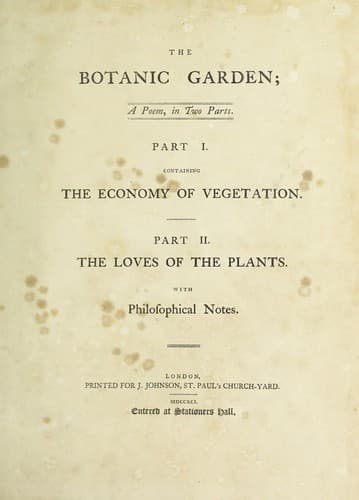
The Botanic Garden. Part 2, Containing the Loves of the Plants. A Poem.: With Philosophical Notes.Darwin, Erasmus
History
The Botanic Garden. Part 2, Containing the Loves of the Plants. A Poem.: With Philosophical Notes.
Darwin, Erasmus
Natural history; Plants -- Poetry
[_Rubia._ l. 375. Madder. Four males and one female. This plant is
cultivated in very large quantities for dying red. If mixed with the food
of young pigs or chickens, it colours their bones red. If they are fed
alternate fortnights with a mixture of madder, and with their usual food
alone, their bones will consist of concentric circles of white and red.
Belchier. Phil. Trans. 1736. Animals fed with madder for the purpose
of these experiments were found upon dissection to have thinner gall.
Comment. de rebus. Lipsiæ. This circumstance is worth further attention.
The colouring materials of vegetables, like those which serve the purpose
of tanning, varnishing, and the various medical purposes, do not seem
essential to the life of the plant; but seem given it as a defence
against the depredations of insects or other animals, to whom these
materials are nauseous or deleterious. To insects and many smaller
animals their colours contribute to conceal them from the larger ones
which prey upon them. Caterpillars which feed on leaves are generally
green; and earth-worms the colour of the earth which they inhabit;
Butterflies which frequent flowers, are coloured like them; small birds
which frequent hedges have greenish backs like the leaves, and light
coloured bellies like the sky, and are hence less visible to the hawk,
who passes under them or over them. Those birds which are much
amongst flowers, as the gold-finch (Fringilla carduelis), are furnished
with vivid colours. The lark, partridge, hare, are the colour of the dry
vegetables or earth on which they rest. And frogs vary their colour with
the mud of the streams which they frequent; and those which live on
trees are green. Fish, which are generally suspended in water, and
swallows, which are generally suspended in air, have their backs the
colour of the distant ground, and their bellies of the sky. In the colder
climates many of these become white during the existence of the snows.
Hence there is apparent design in the colours of animals, whilst those
of vegetables seem consequent to the other properties of the materials
which possess them.]
With chemic art _four_ favour'd youths aloof
380 Stain the white fleece, or stretch the tinted woof;
O'er Age's cheek the warmth of youth diffuse,
Or deck the pale-eyed nymph in roseate hues.
So when MEDEA to exulting Greece
From plunder'd COLCHIS bore the golden fleece;
385 On the loud shore a magic pile she rais'd,
The cauldron bubbled, and the faggots blaz'd;---
Pleased on the boiling wave old ÆSON swims,
And feels new vigour stretch his swelling limbs;
Public-domain text, read in full here on John Shaqi.
Reviews
Reviews
No reviews yet
Be the first to share your thoughts on this work.
Join the Discussion
Join the discussion
Sign in to leave a comment or review.
Sign InorCreate an account