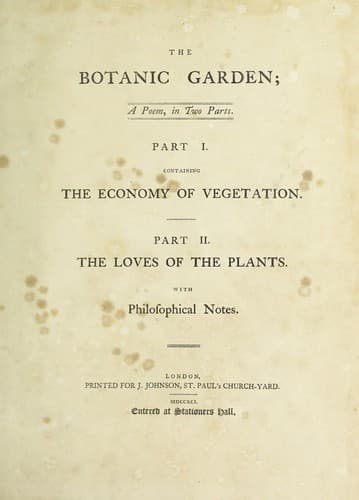
The Botanic Garden. Part 2, Containing the Loves of the Plants. A Poem.: With Philosophical Notes. — John Shaqi
The Botanic Garden. Part 2, Containing the Loves of the Plants. A Poem.: With Philosophical Notes.Darwin, Erasmus
History
The Botanic Garden. Part 2, Containing the Loves of the Plants. A Poem.: With Philosophical Notes.
Darwin, Erasmus
Natural history; Plants -- Poetry
For him she breathes the silent sigh, forlorn,
Each setting-day; for him each rising morn.--
"Bright orbs, that light yon high etherial plain,
400 Or bathe your radiant tresses in the main;
Pale moon, that silver'st o'er night's sable brow;--
For ye were witness to his parting vow!--
Ye shelving rocks, dark waves, and sounding shore,--
Ye echoed sweet the tender words he swore!--
405 Can stars or seas the sails of love retain?
O guide my wanderer to my arms again!"--
Her buoyant skiff intrepid ULVA guides,
And seeks her Lord amid the trackless tides;
[_Ulva_, l. 407. Clandestine marriage. This kind of sea-weed is buoyed
up by bladders of air, which are formed in the duplicatures of its
leaves; and forms immense floating fields of vegetation; the young
ones, branching out from the larger ones, and borne on similar little
air-vessels. It is also found in the warm baths of Patavia; where the
leaves are formed into curious cells or labyrinths for the purpose of
floating on the water. See ulva labyrinthi-formis Lin. Spec. Plant. The
air contained in these cells was found by Dr. Priestley to be sometimes
purer than common air, and sometimes less pure; the air-bladders of fish
seem to be similar organs, and serve to render them buoyant in the water.
In some of these, as in the Cod and Haddock, a red membrane, consisting
of a great number of leaves or duplicatures, is found within the air-bag,
which probably secretes this air from the blood of the animal. (Monro.
Physiol. of Fish. p. 28.) To determine whether this air, when first
separated from the blood of the animal or plant, be dephlogisticated air,
is worthy inquiry. The bladder-sena (Colutea), and bladder-nut
(Staphylæa), have their seed-vessels distended with air; the Ketmia has
the upper joint of the stem immediately under the receptacle of the flower
much distended with air; these seem to be analogous to the air-vessel at
the broad end of the egg, and may probably become less pure as the seed
ripens: some, which I tried, had the purity of the surrounding atmosphere.
The air at the broad end of the egg is probably an organ serving the
purpose of respiration to the young chick, some of whose vessels are
spread upon it like a placenta, or permeate it. Many are of opinion that
even the placenta of the human fetus, and cotyledons of quadrupeds, are
respiratory organs rather than nutritious ones.
The air in the hollow stems of grasses, and of some umbelliferous plants,
bears analogy to the air in the quills, and in some of the bones of
birds; supplying the place of the pith, which shrivels up after it has
performed its office of protruding the young stem or feather. Some of
these cavities of the bones are said to communicate with the lungs in
birds. Phil. Trans.
Public-domain text, read in full here on John Shaqi.
Reviews
Reviews
No reviews yet
Be the first to share your thoughts on this work.
Join the Discussion
Join the discussion
Sign in to leave a comment or review.
Sign InorCreate an account