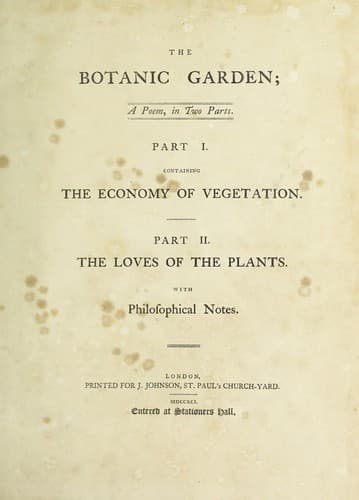
The Botanic Garden. Part 2, Containing the Loves of the Plants. A Poem.: With Philosophical Notes.Darwin, Erasmus
History
The Botanic Garden. Part 2, Containing the Loves of the Plants. A Poem.: With Philosophical Notes.
Darwin, Erasmus
Natural history; Plants -- Poetry
_B._ Has not this been explained by Lucretius, where he describes a
shipwreck; and says, the Spectators receive pleasure from feeling
themselves safe on land? and by Akenside, in his beautiful poem on the
Pleasures of Imagination, who ascribes it to our finding objects for the
due exertion of our passions?
_P_. We must not confound our sensations at the contemplation of real
misery with those which we experience at the scenical representations of
tragedy. The spectators of a shipwreck may be attracted by the dignity
and novelty of the object; and from these may be said to receive
pleasure; but not from the distress of the sufferers. An ingenious
writer, who has criticised this dialogue in the English Review for
August, 1789, adds, that one great source of our pleasure from scenical
distress arises from our, at the same time, generally contemplating one
of the noblest objects of nature, that of Virtue triumphant over
every difficulty and oppression, or supporting its votary under every
suffering: or, where this does not occur, that our minds are relieved
by the justice of some signal punishment awaiting the delinquent. But,
besides this, at the exhibition of a good tragedy, we are not only amused
by the dignity, and novelty, and beauty, of the objects before us; but,
if any distressful circumstances occur too forcible for our sensibility,
we can voluntarily exert ourselves, and recollect, that the scenery is
not real: and thus not only the pain, which we had received from the
apparent distress, is lessened, but a new source of pleasure is opened
to us, similar to that which we frequently have felt on awaking from a
distressful dream; we are glad that it is not true. We are at the same
time unwilling to relinquish the pleasure which we receive from the other
interesting circumstances of the drama; and on that account quickly
permit ourselves to relapse into the delusion; and thus alternately
believe and disbelieve, almost every moment, the existence of the objects
represented before us.
_B_. Have those two sovereigns of poetic land, HOMER and SHAKESPEAR, kept
their works entirely free from the Horrid?--or even yourself in your
third Canto?
_P_. The descriptions of the mangled carcasses of the companions of
Ulysses, in the cave of Polypheme, is in this respect certainly
objectionable, as is well observed by Scaliger. And in the play of Titus
Andronicus, if that was written by Shakespear (which from its internal
evidence I think very improbable), there are many horrid and disgustful
circumstances. The following Canto is submitted to the candour of the
critical reader, to whose opinion I shall submit in silence.
THE
LOVES
OF THE
PLANTS.
CANTO III.
Public-domain text, read in full here on John Shaqi.
Reviews
Reviews
No reviews yet
Be the first to share your thoughts on this work.
Elsewhere in the archive
Join the Discussion
Join the discussion
Sign in to leave a comment or review.
Sign InorCreate an account