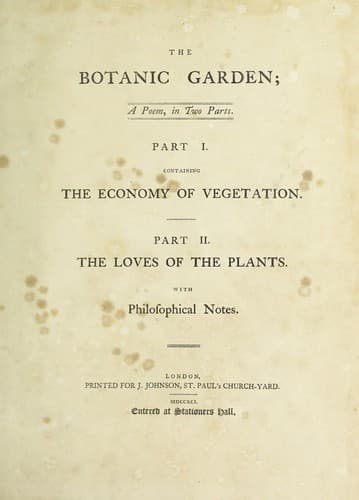
The Botanic Garden. Part 2, Containing the Loves of the Plants. A Poem.: With Philosophical Notes.Darwin, Erasmus
History
The Botanic Garden. Part 2, Containing the Loves of the Plants. A Poem.: With Philosophical Notes.
Darwin, Erasmus
Natural history; Plants -- Poetry
[_Meadia_. l. 61. Dodecatheon, American Cowslip. Five males and one
female. The males, or anthers, touch each other. The uncommon beauty of
this flower occasioned Linneus to give it a name signifying the twelve
heathen gods; and Dr. Mead to affix his own name to it. The pistil is
much longer than the stamens, hence the flower-stalks have their elegant
bend, that the stigma may hang downwards to receive the fecundating dust
of the anthers. And the petals are so beautifully turned back to prevent
the rain or dew drops from sliding down and washing off this dust
prematurely; and at the same time exposing it to the light and air. As
soon as the seeds are formed, it erects all the flower-stalks to prevent
them from falling out; and thus loses the beauty of its figure. Is this
a mechanical effect, or does it indicate a vegetable storgé to preserve
its offspring? See note on Ilex, and Gloriosa.
In the Meadia, the Borago, Cyclamen, Solanum, and many others, the
filaments are very short compared with the slyle. Hence it became
necessary, 1st. to furnish the stamens with long anthers. 2d. To lengthen
and bend the peduncle or flower-slalk, that the flower might hang
downwards. 3d. To reflect the petals. 4th. To erect these peduncles when
the germ was fecundated. We may reason upon this by observing, that all
this apparatus might have been spared, if the filaments alone had grown
longer; and that thence in these flowers that the filaments are the most
unchangeable parts; and that thence their comparative length, in respect
to the style, would afford a most permanent mark of their generic
character.]
[Illustration: Meadia]
65 Woo'd with long care, CURCUMA cold and shy
Meets her fond husband with averted eye:
_Four_ beardless youths the obdurate beauty move
With soft attentions of Platonic love.
With vain desires the pensive ALCEA burns,
70 And, like sad ELOISA, loves and mourns.
The freckled IRIS owns a fiercer flame,
And _three_ unjealous husbands wed the dame.
CUPRESSUS dark disdains his dusky bride,
_One_ dome contains them, but _two_ beds divide.
75 The proud OSYRIS flies his angry fair,
_Two_ houses hold the fashionable pair.
Public-domain text, read in full here on John Shaqi.
Reviews
Reviews
No reviews yet
Be the first to share your thoughts on this work.
Join the Discussion
Join the discussion
Sign in to leave a comment or review.
Sign InorCreate an account