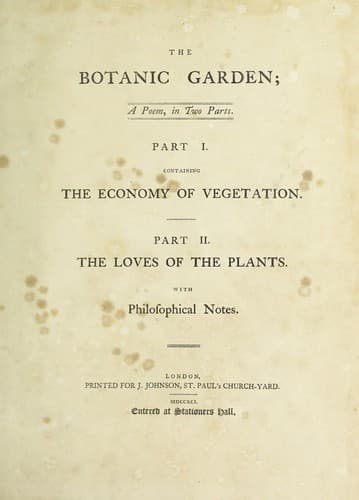
The Botanic Garden. Part 2, Containing the Loves of the Plants. A Poem.: With Philosophical Notes.Darwin, Erasmus
History
The Botanic Garden. Part 2, Containing the Loves of the Plants. A Poem.: With Philosophical Notes.
Darwin, Erasmus
Natural history; Plants -- Poetry
_Poet_. It has been already observed, that the principal part of the
language of poetry consists of those words, which are expressive of the
ideas, which we originally receive by the organ of sight; and in this it
nearly indeed resembles painting; which can express itself in no other
way, but by exciting the ideas or sensations belonging to the sense of
vision. But besides this essential similitude in the language of the
poetic pen and pencil, these two sisters resemble each other, if I may
so say, in many of their habits and manners. The painter, to produce a
strong effect, makes a few parts of his picture large, distinct, and
luminous, and keeps the remainder in shadow, or even beneath its natural
size and colour, to give eminence to the principal figure. This is
similar to the common manner of poetic composition, where the subordinate
characters are kept down, to elevate and give consequence to the hero or
heroine of the piece.
In the south aile of the cathedral church at Lichfield, there is an
antient monument of a recumbent figure; the head and neck of which lie
on a roll of matting in a kind of niche or cavern in the wall; and about
five feet distant horizontally in another opening or cavern in the wall
are seen the feet and ankles, with some folds of garment, lying also on
a matt; and though the intermediate space is a solid stone-wall, yet the
imagination supplies the deficiency, and the whole figure seems to exist
before our eyes. Does not this resemble one of the arts both of the
painter and the poet? The former often shows a muscular arm amidst a
group of figures, or an impassioned face; and, hiding the remainder of
the body behind other objects, leaves the imagination to compleat it. The
latter, describing a single feature or attitude in picturesque words,
produces before the mind an image of the whole.
I remember seeing a print, in which was represented a shrivelled hand
stretched through an iron grate, in the stone floor of a prison-yard, to
reach at a mess of porrage, which affected me with more horrid ideas of
the distress of the prisoner in the dungeon below, than could have
been perhaps produced by an exhibition of the whole person. And in the
following beautiful scenery from the Midsummer-night's dream, (in which I
have taken the liberty to alter the place of a comma), the description of
the swimming step and prominent belly bring the whole figure before our
eyes with the distinctness of reality.
When we have laugh'd to see the sails conceive,
And grow big-bellied with the wanton wind;
Which she with pretty and with swimming gate,
Following her womb, (then rich with my young squire),
Would imitate, and sail upon the land.
Public-domain text, read in full here on John Shaqi.
Reviews
Reviews
No reviews yet
Be the first to share your thoughts on this work.
Elsewhere in the archive
Join the Discussion
Join the discussion
Sign in to leave a comment or review.
Sign InorCreate an account