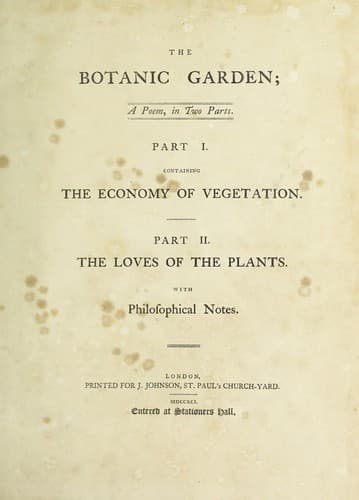
The Botanic Garden. Part 2, Containing the Loves of the Plants. A Poem.: With Philosophical Notes.Darwin, Erasmus
History
The Botanic Garden. Part 2, Containing the Loves of the Plants. A Poem.: With Philosophical Notes.
Darwin, Erasmus
Natural history; Plants -- Poetry
There is a third sister-feature, which belongs both to the pictorial and
poetic art; and that is the making sentiments and passions visible, as
it were, to the spectator; this is done in both arts by describing or
portraying the effects or changes which those sentiments or passions
produce upon the body. At the end of the unaltered play of Lear, there
is a beautiful example of poetic painting; the old King is introduced as
dying from grief for the loss of Cordelia; at this crisis, Shakespear,
conceiving the robe of the king to be held together by a clasp,
represents him as only saying to an attendant courtier in a faint voice,
"Pray, Sir, undo this button,--thank you, Sir," and dies. Thus by the
art of the poet, the oppression at the bosom of the dying King is made
visible, not described in words.
_B_. What are the features, in which these Sister-arts do not resemble
each other?
_P_. The ingenious Bishop Berkeley, in his Treatise on Vision, a work of
great ability, has evinced, that the colours, which we see, are only a
language suggesting to our minds the ideas of solidity and extension,
which we had before received by the sense of touch. Thus when we view the
trunk of a tree, our eye can only acquaint us with the colours or shades;
and from the previous experience of the sense of touch, these suggest to
us the cylindrical form, with the prominent or depressed wrinkles on
it. From hence it appears, that there is the strictest analogy between
colours and sounds; as they are both but languages, which do not
represent their correspondent ideas, but only suggest them to the mind
from the habits or associations of previous experience. It is therefore
reasonable to conclude, that the more artificial arrangements of these
two languages by the poet and the painter bear a similar analogy.
But in one circumstance the Pen and the Pencil differ widely from each
other, and that is the quantity of Time which they can include in their
respective representations. The former can unravel a long series of
events, which may constitute the history of days or years; while the
latter can exhibit only the actions of a moment. The Poet is happier in
describing successive scenes; the Painter in representing stationary
ones: both have their advantages.
Public-domain text, read in full here on John Shaqi.
Reviews
Reviews
No reviews yet
Be the first to share your thoughts on this work.
Elsewhere in the archive
Join the Discussion
Join the discussion
Sign in to leave a comment or review.
Sign InorCreate an account