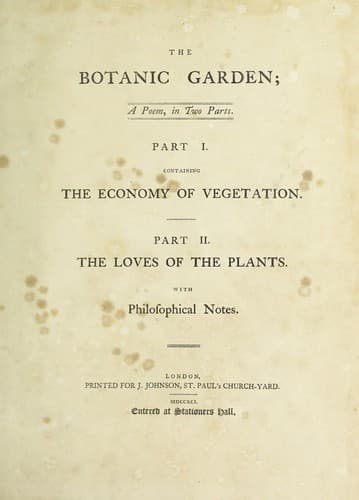
The Botanic Garden. Part 2, Containing the Loves of the Plants. A Poem.: With Philosophical Notes.Darwin, Erasmus
History
The Botanic Garden. Part 2, Containing the Loves of the Plants. A Poem.: With Philosophical Notes.
Darwin, Erasmus
Natural history; Plants -- Poetry
Where the passions are introduced, as the Poet, on one hand, has the
power gradually to prepare the mind of his reader by previous climacteric
circumstances; the Painter, on the other hand, can throw stronger
illumination and distinctness on the principal moment or catastrophe of
the action; besides the advantage he has in using an universal language,
which can be _read_ in an instant of time. Thus where a great number of
figures are all seen together, supporting or contrasting each other, and
contributing to explain or aggrandize the principal effect, we view
a picture with agreeable surprize, and contemplate it with unceasing
admiration. In the representation of the sacrifice of Jephtha's Daughter,
a print done from a painting of Ant. Coypel, at one glance of the eye
we read all the interesting passages of the last act of a well-written
tragedy; so much poetry is there condensed into a moment of time.
_B._ Will you now oblige me with an account of the relationship between
Poetry, and her other sister, Music? _P_. In the poetry of our language
I don't think we are to look for any thing analogous to the notes of the
gamut; for, except perhaps in a few exclamations or interrogations, we
are at liberty to raise or sink our voice an octave or two at pleasure,
without altering the sense of the words. Hence, if either poetry or prose
be read in melodious tones of voice, as is done in recitativo, or in
chaunting, it must depend on the speaker, not on the writer: for though
words may be selected which are less harsh than others, that is, which
have fewer sudden stops or abrupt consonants amongst the vowels, or
with fewer sibilant letters, yet this does not constitute melody, which
consists of agreeable successions of notes referrable to the gamut; or
harmony, which consists of agreeable combinations of them. If the Chinese
language has many words of similar articulation, which yet signify
different ideas, when spoken in a higher or lower musical note, as some
travellers affirm, it must be capable of much finer effect, in respect to
the audible part of poetry, than any language we are acquainted with.
There is however another affinity, in which poetry and music more nearly
resemble each other than has generally been understood, and that is in
their measure or time. There are but two kinds of time acknowledged in
modern music, which are called _triple time_, and _common time_. The
former of these is divided by bars, each bar containing three crotchets,
or a proportional number of their subdivisions into quavers and
semiquavers. This kind of time is analogous to the measure of our heroic
or iambic verse. Thus the two following couplets are each of them divided
into five bars of _triple time_, each bar consisting of two crotchets and
two quavers; nor can they be divided into bars analogous to _common time_
without the bars interfering with some of the crotchets, so as to divide
them.
Public-domain text, read in full here on John Shaqi.
Reviews
Reviews
No reviews yet
Be the first to share your thoughts on this work.
Elsewhere in the archive
Join the Discussion
Join the discussion
Sign in to leave a comment or review.
Sign InorCreate an account