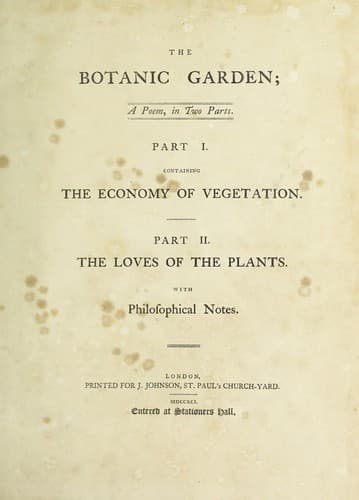
The Botanic Garden. Part 2, Containing the Loves of the Plants. A Poem.: With Philosophical Notes.Darwin, Erasmus
History
The Botanic Garden. Part 2, Containing the Loves of the Plants. A Poem.: With Philosophical Notes.
Darwin, Erasmus
Natural history; Plants -- Poetry
_Tropæolum._ l. 45. Majus. Garden Nasturtion, or greater Indian cress.
Eight males, one female. Miss E. C. Linneus first observed the Tropæolum
Majus to emit sparks or flashes in the mornings before sun-rise, during
the months of June or July, and also during the twilight in the evening,
but not after total darkness came on; these singular scintillations were
shewn to her father and other philosophers; and Mr. Wilcke, a celebrated
electrician, believed them to be electric. Lin. Spec. Plantar. p. 490.
Swedish Acts for the year 1762. Pulteney's View of Linneus, p. 220. Nor
is this more wonderful than that the electric eel and torpedo should give
voluntary shocks of electricity; and in this plant perhaps, as in those
animals, it may be a mode of defence, by which it harrasses or destroys
the night-flying insects which infest it; and probably it may emit the same
sparks during the day, which must be then invisible. This curious subject
deserves further investigation. See Dictamnus. The ceasing to shine of
this plant after twilight might induce one to conceive, that it
absorbed and emitted light, like the Bolognian Phosphorus, or calcined
oyster-shells, so well explained by Mr. B. Wilson, and by T. B. Beccari.
Exper. on Phosphori, by B. Wilson. Dodsley. The light of the evening,
at the same distance from noon, is much greater, as I have repeatedly
observed, than the light of the morning: this is owing, I suppose, to the
phosphorescent quality of almost all bodies, in a greater or less degree,
which thus absorb light during the sun-shine, and continue to emit it
again for some time afterwards, though not in such quantity as to produce
apparent scintillations. The nectary of this plant grows from what is
supposed to be the calyx; but this supposed calyx is coloured; and
perhaps, from this circumstance of its bearing the nectary, should rather
be esteemed a part of the coral. See an additional note at the end of the
poem.]
_Eight_ watchful swains along the lawns of night
With amorous steps pursue the virgin light;
O'er her fair form the electric lustre plays,
50 And cold she moves amid the lambent blaze.
So shines the glow-fly, when the sun retires,
And gems the night-air with phosphoric fires;
[_So shines the glow-fly._ l. 52. In Jamaica, in some seasons of the year,
the fire-flies are seen in the evenings in great abundance. When they
settle on the ground, the bull-frog greedily devours them; which seems to
have given origin to a curious, though cruel, method of destroying these
animals: if red-hot pieces of charcoal be thrown towards them in the dusk
of the evening, they leap at them, and, hastily swallowing them, are
burnt to death.]
Public-domain text, read in full here on John Shaqi.
Reviews
Reviews
No reviews yet
Be the first to share your thoughts on this work.
Elsewhere in the archive
Join the Discussion
Join the discussion
Sign in to leave a comment or review.
Sign InorCreate an account