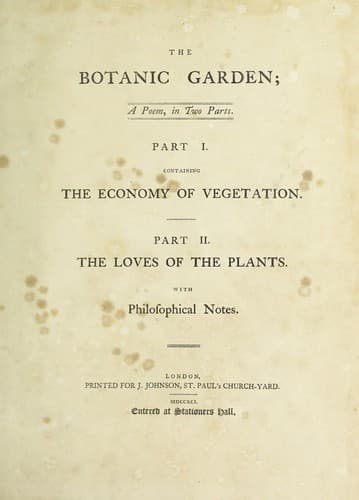
The Botanic Garden. Part 2, Containing the Loves of the Plants. A Poem.: With Philosophical Notes.Darwin, Erasmus
History
The Botanic Garden. Part 2, Containing the Loves of the Plants. A Poem.: With Philosophical Notes.
Darwin, Erasmus
Natural history; Plants -- Poetry
Thus o'er the marsh aërial lights betray,
And charm the unwary wanderer from his way.
55 So when thy King, Assyria, fierce and proud,
Three human victims to his idol vow'd;
Rear'd a vast pyre before the golden shrine
Of sulphurous coal, and pitch-exsuding pine;--
--Loud roar the flames, the iron nostrils breathe,
60 And the huge bellows pant and heave beneath;
Bright and more bright the blazing deluge flows,
And white with seven-fold heat the furnace glows.
And now the Monarch fix'd with dread surprize
Deep in the burning vault his dazzled eyes.
65 "Lo! Three unbound amid the frightful glare,
Unscorch'd their sandals, and unsing'd their hair!
And now a fourth with seraph-beauty bright
Descends, accosts them, and outshines the light!
Fierce flames innocuous, as they step, retire!
70 And slow they move amid a world of fire!"
He spoke,--to Heaven his arms repentant spread,
And kneeling bow'd his gem-incircled head.
_Two_ Sister-Nymphs, the fair AVENAS, lead
Their fleecy squadrons on the lawns of Tweed;
75 Pass with light step his wave-worn banks along,
And wake his Echoes with their silver tongue;
Or touch the reed, as gentle Love inspires,
In notes accordant to their chaste desires.
I.
"Sweet ECHO! sleeps thy vocal shell,
"Where this high arch o'erhangs the dell;
"While Tweed with sun-reflecting streams
"Chequers thy rocks with dancing beams?--
[_Ovena_. l. 73. Oat. The numerous families of grasses have all three
males, and two females, except Anthoxanthum, which gives the grateful
smell to hay, and has but two males. The herbs of this order of
vegetables support the countless tribes of graminivorous animals. The
seeds of the smaller kinds of grasses, as of aira, poa, briza, stipa,
&c. are the sustenance of many sorts of birds. The seeds of the large
grasses, as of wheat, barley, rye, oats, supply food to the human
species.
It seems to have required more ingenuity to think of feeding nations of
mankind with so small a seed, than with the potatoe of Mexico, or the
bread-fruit of the southern islands; hence Ceres in Egypt, which was the
birth-place of our European arts, was deservedly celebrated amongst their
divinities, as well as Osyris, who invented the Plough.
Public-domain text, read in full here on John Shaqi.
Reviews
Reviews
No reviews yet
Be the first to share your thoughts on this work.
Elsewhere in the archive
Join the Discussion
Join the discussion
Sign in to leave a comment or review.
Sign InorCreate an account