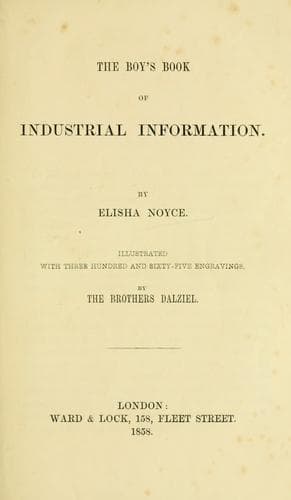
The Boy's Book of Industrial InformationNoyce, Elisha
General
The Boy's Book of Industrial Information
Noyce, Elisha
Industrial arts -- Juvenile literature; Technology -- Juvenile literature
In oil-gilding, where frames, &c., are to be covered with gold-leaf,
the first thing necessary is to obtain a smooth even surface on which
it will lie, but as carved frames are expensive, ornaments of a kind
of putty are fixed to the frame, and coated with whiting and size.
The gold-leaf is made to adhere easily to this clammy surface, by
simply damping it, and pressing the gold on by means of a piece of
cotton wool, afterwards gently brushing it into all the markings.
Wood and other articles to be gilt are coated with “gold-size,”--a
sort of varnish--and when this is nearly dried, so as to be what
is called “tackey,” it will hold the gold in the same way. When
lettering is to be done in gold, the painted or varnished surface
is first brushed over with whiting, which prevents the gold adhering
where it is not wanted, the writing is then executed in gold-size,
and the gold-leaf applied by pressing the book on to the surface, and
finishing off with cotton wool, which rubs off all the superfluous
gold-leaf and smooths it on the surface.
Water-gilding (a process, however, in which no water is used)
consists in covering the surface of metal with a thin coating
of gold; the best metal for water-gilding is either brass, or a
mixture of brass and copper. A mixture of gold and mercury, in
the proportion of one part of gold to eight of mercury, is made
hot over a fire till they have united; it is then put into a bag
of chamois-leather, and the superfluous mercury pressed out. What
remains is called an “amalgam;” it is soft, and of a greasy nature,
so that it can be smeared over any surface with the fingers. The
articles to be gilt are made perfectly clean on the surface, and a
liquid made by dissolving mercury in nitric acid (aqua-fortis) is
brushed over them by means of a brush made of fine brass wire, called
a “scratch-brush.” The mercury immediately adheres to the surface of
the metal, making it look like silver, when this is done, a little
of the amalgam is rubbed on, and the article evenly covered with it.
It is now heated in a charcoal fire till all the mercury evaporates,
and the brass is left with a coating of gold, which is very dull but
may be burnished with a steel burnisher and made bright if necessary.
In former times articles were inlaid with thin plates of gold, which
were placed in hollows made with a graver and melted in, a little
borax being applied between.
When a solution of “chloride of gold” is mixed with ether, the ether
takes the gold away from the solution, and may be poured off the top
charged with it. This solution, if applied to polished steel by means
of a camel-hair pencil, rapidly evaporates, leaving a film of gold
adhering to the steel, which, when burnished with any hard substance,
has a very elegant appearance. In this way any ornamental design in
gold may be produced, but it is not very durable. The gilt ornaments,
scrolls, and mottoes on sword-blades, &c., are sometimes done in this
way.
Public-domain text, read in full here on John Shaqi.
Reviews
Reviews
No reviews yet
Be the first to share your thoughts on this work.
Elsewhere in the archive
Join the Discussion
Join the discussion
Sign in to leave a comment or review.
Sign InorCreate an account