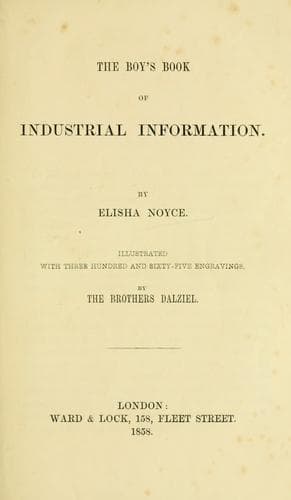
The Boy's Book of Industrial InformationNoyce, Elisha
General
The Boy's Book of Industrial Information
Noyce, Elisha
Industrial arts -- Juvenile literature; Technology -- Juvenile literature
The official report of General Desvaux on the artesian borings
executed in the Desert of Zahara of the province of Constantine,
in 1856-7, states, “that a spring affording 4010 quarts of water
per minute, was the result of one of the borings, and that others
affording 35, 120, and 4,300 quarts respectively were successively
completed.” And he goes on to say: “When the shouts of the soldiers
announced the gush, the Arabs sprang in crowds to the spot, laving
themselves in the welcome abundance, into which mothers dipped their
children; while the old Sheik fell upon his knees and wept, returning
thanks to Allah and the French. At Oum Thiour a well sunk to the
depth of 170 metres and yielding 180 quarts a minute was at once
taken as the centre of a settlement by a portion of a previously
nomadic tribe.... As soon as the water appeared they began the
construction of a village, the plantation of 1,200 date trees,
and entirely renounced their wandering existence.”
According to General Desvaux’s report, these artesian wells are
likely to have a most important influence on Arab life, and greatly
to subdue the roving propensities of many of the tribes.
MINES.
Mines are excavations made in the earth for the purpose of raising
the various minerals which exist below its surface, such as coal,
rock-salt, and the various ores from which metals are extracted (see
“Smelting”). Mines consist of those which contain minerals that lie
in strata _parallel_ (or nearly so) to the surface of the earth, as
coal, rock-salt, or iron-stone, and those containing the ores and
minerals which are imbedded in seams or fissures of the primitive
rocks, and are nearly _perpendicular_ to the surface. Of the former
kind, coal-mines form the chief examples. When indications of coal
are discovered, a “boring” is commenced to ascertain its existence,
and the depth at which it is placed below the surface. Each piece of
earth raised by the boring-tools is placed one beside the other, in
the exact order in which they are raised, so as to show the kind of
earth being bored through, and the thickness of each strata between
the surface of the earth and the seam of coal; and it sometimes
happens that the boring is stopped on arriving at certain kinds of
rock--the old red sandstone, for example--for it would be useless
to continue boring beyond this, no coal ever existing below it.
Public-domain text, read in full here on John Shaqi.
Reviews
Reviews
No reviews yet
Be the first to share your thoughts on this work.
Elsewhere in the archive
Join the Discussion
Join the discussion
Sign in to leave a comment or review.
Sign InorCreate an account