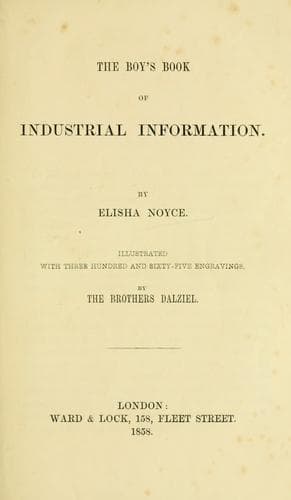
The Boy's Book of Industrial InformationNoyce, Elisha
General
The Boy's Book of Industrial Information
Noyce, Elisha
Industrial arts -- Juvenile literature; Technology -- Juvenile literature
process a twist is given to it in one direction and two of these
wound on to another receiving a twist in an opposite direction, this
forms a fine cord called “organzine,” which is used by the silk
weaver in the same way that yarn is by the cotton weaver. The short
and broken pieces are carded and spun like cotton, and is called
floss silk. The raw silk is of a bright buff or golden yellow color,
but there are some kinds which are white.
INDIA-RUBBER.
India-rubber or Caoutchouc which was, a short time back, used only
for the very insignificant purpose of rubbing out pencil marks,
is now used for almost innumerable purposes. India-rubber is the
solidified juice of several trees, such as the _Siphonia_, _Jatropha
Elastica_, _Ficus Elastica_, &c., the juice is got by making
incisions in the trunk of the trees during winter and collecting
the juice, which is caoutchouc combined with water, in the form of
a milky thick fluid, the water is then allowed to evaporate and the
India-rubber remains. It is brought here in all sorts of shapes, and
is purified before it is fit for commercial use by washing in warm
water or steaming; it is then cut into pieces and put into a kneading
machine which cuts and works it together with such rapidity that it
becomes quite hot and the pieces join into one mass. After having
undergone every kind of torture that can be well imagined in the
form of cutting, tearing, and squeezing, it is finally compressed in
a square cast iron mould, where it is kept for a time, and then is
fit for any use it has to be applied to. What is called vulcanized
India-rubber is produced by incorporating it with powdered sulphur,
or some substance containing it, as sulphuret of antimony, or the
vapour of sulphur is kneaded into the mass; this vulcanized rubber is
very elastic and does not harden by cold. Waterproof fabrics are made
by stretching the stuff to be waterproofed on a frame, at one end of
which is a partition having a slit in it, through which it is drawn,
after having been smeared with a solution of India-rubber in naptha;
the slit is so narrow that it scrapes off all superfluous caoutchouc,
it is then dried in the air.
GUTTA-PERCHA.
Public-domain text, read in full here on John Shaqi.
Reviews
Reviews
No reviews yet
Be the first to share your thoughts on this work.
Join the Discussion
Join the discussion
Sign in to leave a comment or review.
Sign InorCreate an account