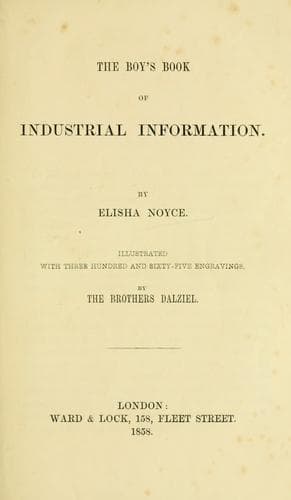
The Boy's Book of Industrial InformationNoyce, Elisha
General
The Boy's Book of Industrial Information
Noyce, Elisha
Industrial arts -- Juvenile literature; Technology -- Juvenile literature
The raw, or Muscovado sugar as it is called, is a brownish compound
of small crystals of sugar held together by molasses or treacle,
which gives the sugar its color and peculiar moistness; when pure,
sugar is quite white and capable of crystallization, as may be seen
in sugar candy, which is crystallized sugar; sugar, if heated,
becomes converted into a dark brown liquid called burnt sugar
or “caramel,” this has an intensely rich color, but scarcely any
sweetness; it is used to color wines and spirits. The tendency of
sugar to be converted into caramel is very great, and the whole
difficulty of sugar refining depends upon this fact, for a solution
of sugar heated is constantly changing into this substance.
To obtain the sugar from the sugar cane, it is first crushed between
powerful rollers, by which all the juice is pressed out, this is
immediately clarified by boiling it strongly with a small quantity
of slaked lime, or it would speedily ferment, it is then put into
evaporating pans, in which it is evaporated till it is ready to
crystallize or granulate; from these pans it is ladled out into a
cooler, and from thence into wooden boxes where it granulates; the
next process is called “curing” this consists of draining the sugar
of its molasses, for this purpose hogsheads or large broad barrels
are arranged on a sloping floor, and having several holes at their
lower part with a piece of plantain leaf put into them; through these
holes the molasses runs out and is collected in a vessel for the
purpose. The best kinds of sugar are partly purified by a process
called “claying;” this consists in putting the sugar into conical
earthen jars, with a hole at the point which is turned downwards;
the top is piled up with a mass of wet clay, the moisture from which
slowly sinks down, carrying with it most of the coloring matter of
the sugar; the cone of sugar is afterwards dried, broken up, and each
part ground up separately, as they form sugars of different value,
the point being the brownest and the base of the cone the whitest.
Sugar is made from the beet root in the same way as from the cane,
the roots being rasped up into a pulp by a wheel with a notched edge
acting against them. Beet-root sugar crystallizes better than cane
sugar; otherwise it is exactly like it, and purifies as well.
ALCOHOL, OR SPIRIT.
Public-domain text, read in full here on John Shaqi.
Reviews
Reviews
No reviews yet
Be the first to share your thoughts on this work.
Join the Discussion
Join the discussion
Sign in to leave a comment or review.
Sign InorCreate an account