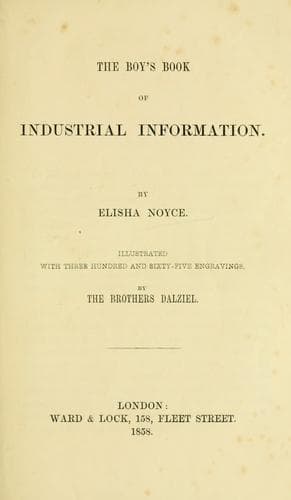
The Boy's Book of Industrial InformationNoyce, Elisha
General
The Boy's Book of Industrial Information
Noyce, Elisha
Industrial arts -- Juvenile literature; Technology -- Juvenile literature
Starch exists naturally in various kinds of grain, as wheat and
barley, and in the roots and tubers of many plants, as potatoes.
The process of extracting the starch, and separating it from the
other constituents of the seed or root, consists, essentially, of
crushing it, and wishing out the starch with cold water; the liquid
resulting from this mode of treatment is of a milky whiteness, and
deposits starch by sediment. This liquid is passed through five
sieves to separate the husks and skins, and when the starch has
settled, and the liquid fermented and become sour, it is drawn off;
it is allowed to become sour as the gluten of the grain is more
completely separated by so doing. The starch is repeatedly stirred,
allowed to settle, and the water drawn off, till it is quite pure;
the top of the starch is scraped to separate any slime adhering, and
the pure starch dug out with wooden shovels and put in a box lined
with linen, in which the moisture drains off; the cakes taken from
these boxes are cut up into squares, put upon bricks, and dried by a
gentle heat; the squares are then scraped clean and packed in paper
for sale, in these packages it breaks up into pieces, so that when
they are opened, the starch has that peculiar appearance so familiar,
and almost resembling six-sided columns. Arrow-root is the starch
obtained from a West Indian plant called _Maranta Arundinacea_.
Cassava and Tapioca are starches from the manioc, and Sago, from
the sago palm. Starch, under the microscope, appears in the form
of minute globules, and is quite insoluble in cold water, in which
it falls to the bottom, leaving the water at the upper part quite
clear; but water that is nearly boiling (that is to say at 160 deg.
of Fahrenheit’s thermometer, or above), breaks or dissolves the
granules, and the starch forms with it a sort of paste, this is
the liquid used for stiffening linen and other articles in domestic
laundry.
The starch sold in this country is colored blueish by smalt or
indigo; but on the continent is used of its natural white color. If
starch be baked in an oven at the temperature of about 300 deg. it
becomes, to a great extent, soluble in cold water, forming what is
called “British gum,” this is largely used for calico printing and
other purposes; if boiled in water under great pressure, so that
the temperature can be raised to the same degree, it is also changed
into an adhesive sort of gum--this is the substance made use of
by the government authorities to spread over the backs of postage
and receipt stamps to make them adhere. The starch of grain during
germination, or growth, becomes converted into sugar; the same effect
can be produced by heating starch with diluted sulphuric acid.
SOAP.
Illustration: (‡ SOAP MAKING.)
Illustration: CUTTING SOAP.
Illustration: COPPERS FOR THE MIXING PROCESS.
Public-domain text, read in full here on John Shaqi.
Reviews
Reviews
No reviews yet
Be the first to share your thoughts on this work.
Join the Discussion
Join the discussion
Sign in to leave a comment or review.
Sign InorCreate an account