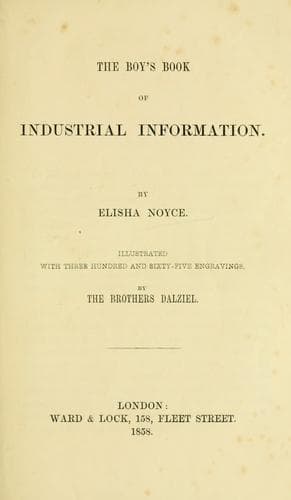
The Boy's Book of Industrial InformationNoyce, Elisha
General
The Boy's Book of Industrial Information
Noyce, Elisha
Industrial arts -- Juvenile literature; Technology -- Juvenile literature
results is called by the workmen “black ball.” It is taken out and
put into a cistern; water is then poured over it, and after stirring,
it is drained off and evaporated to a dry mass; this is impure soda.
It is mixed with coal-dust, again burnt, again washed and evaporated,
by this second process the soda ash is produced, which, being
dissolved, filtered and evaporated, produces large crystals of soda.
The large quantity of hydrochloric acid produced in the first part
of the process, is used in the of making chloric of lime. A few years
back, soda was got from the ashes of the plant called “salsola soda,”
and sold in the form of an impure carbonate called “barilla.”
WINES.
Illustration: WINE MAKING.
Wine is made from the juice of grapes. When the grapes are ripe, they
are gathered and at once put into a press, by which all the juice
is squeezed out, and the skins, stalks, and seeds left in the press.
This juice, which is called “must,” is allowed to ferment, which it
does of its own accord, in the countries where grapes most abound,
and at the season of the year when they are gathered, without the
addition of yeast or other ferment; in a few days nearly all the
sugary matter contained in the “must” becomes converted into spirit,
and it has now the pungent taste of wine; (if the wine is allowed
to ferment too long, it is very apt to become sour), the wine is now
put into casks and kept for a time, during which a slow fermentation
goes on, and that substance, which is called “tartar,” is deposited
in the form of a thick crust of an acidulus taste and brown color;
when purified till it is quite white, it forms the cream of tartar of
the druggists’ shop. The color of wine depends upon the color of the
grapes used, whether white or black.
Wine, at a general average, contains about 20 per cent. of spirit
or alcohol; when port wine is put into bottles, a slow fermentation
continues to go on, and a crust of tartar is deposited similar to
that described above, and it is the separation of this tartar which
causes port wine to improve by age.
What are called British wines, are liquids mostly made by fermenting
the juice of the fruits whose name they bear, as currant wine,
gooseberry wine, &c.; but as the climate of this country is not
favorable to the growth of grapes, or the spontaneous fermentation
of their juice, the grape wine of England is very inferior to the
foreign. The juice of any fruit required to make wine of, has to be
fermented artificially; this is generally done by making it slightly
warm, and floating on the surface a piece of bread soaked with
yeast; the wines thus produced are very apt to become sour, and it
is generally necessary to add brandy to preserve them. Many of the
British wines sold in London are made of an impure weak spirit called
“faints,” sweetened and flavored with various substances, as ginger,
orange-peel, &c. and sell for ginger or orange wine.
Public-domain text, read in full here on John Shaqi.
Reviews
Reviews
No reviews yet
Be the first to share your thoughts on this work.
Join the Discussion
Join the discussion
Sign in to leave a comment or review.
Sign InorCreate an account