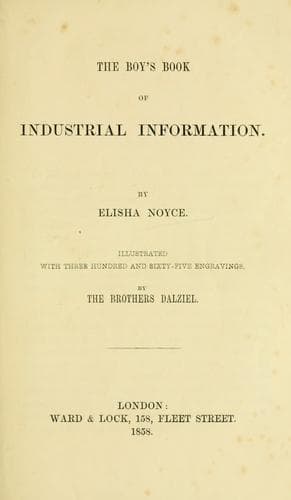
The Boy's Book of Industrial InformationNoyce, Elisha
General
The Boy's Book of Industrial Information
Noyce, Elisha
Industrial arts -- Juvenile literature; Technology -- Juvenile literature
Varnishes are solutions of various resinous substances that will
dry with a bright surface on exposure to the air. They are used to
protect different substances from the action of the atmosphere, and
to give them an elegant bright surface; woods and painted work are
the chief things varnished; metals are coated with a kind of varnish
called “lacquer,” this is to prevent the bright surface of the metal
from being dulled by the air or damp, and to give an artificial
appearance to some metals; tin, for instance, if lacquered with
yellow lacquer, acquires somewhat the appearance of brass. Mastic
varnish is the varnish generally used for paper and pictures; it is
made by dissolving gum mastic in oil of turpentine. Copal varnish
is that most generally used for carriages and wood, it is made by
adding boiled linseed oil to melted copal, and afterwards thinning it
with oil of turpentine. A common varnish, fit for many purposes, may
be made by adding common resin to oil of turpentine, and warming it
till dissolved. Lacquers are made by dissolving shellac and various
other gums in strong spirits of wine, and in some cases coloring it,
either yellow, by means of gamboge, or red, by dragon’s blood (a kind
of resin). French polish is nearly the same as lacquer, but the mode
of applying it is different; the grain of the wood is first filled
up by means of drying oil and chalk rubbed in, when this becomes
thoroughly dry, a rubber of flannel is covered by a piece or two of
clean old linen, and some of the polish put on it, just enough to
moisten it, and then a little oil, this is slowly rubbed round and
round, the varnish adhering to the wood, and the oil preventing the
rubber sticking to it, and at the same time, polishing the surface of
the varnish as it dries. This process requires a good deal of art to
produce a perfect surface. Old work, before being varnished with any
varnish that contains oil (as copal varnish), should be thoroughly
freed from grease or greasy matter, or the varnish will never dry.
Good varnish should dry in twenty-four hours so that dust will not
adhere to it.
OILS.
Illustration: PRESSING LINSEED FOR OIL.
Oils, whether animal or vegetable, have pretty much the same
properties. The vegetable oils are got by crushing and pressing
certain seeds, as linseed; the animal oils are obtained chiefly
from the whale and seal tribe, or from fish, as the cod and sturgeon.
They are viscid and of a pale yellow color, lighter than water, and
therefore float upon it, and are very combustible. Oils are used for
a multiplicity of purposes: for burning in lamps, for making paints
and varnishes, preventing the friction of machinery, in making soap,
and numerous other processes. Oils are generally divided into fixed
and volatile oils; as an example of the first, linseed oil may be
selected; of the last, oil of lavender.
Public-domain text, read in full here on John Shaqi.
Reviews
Reviews
No reviews yet
Be the first to share your thoughts on this work.
Join the Discussion
Join the discussion
Sign in to leave a comment or review.
Sign InorCreate an account