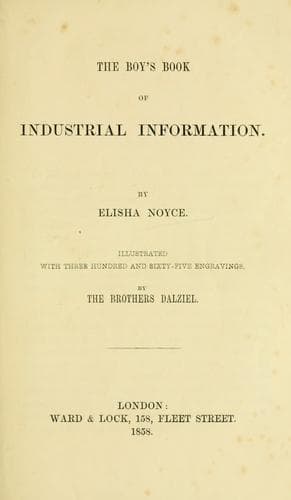
The Boy's Book of Industrial InformationNoyce, Elisha
General
The Boy's Book of Industrial Information
Noyce, Elisha
Industrial arts -- Juvenile literature; Technology -- Juvenile literature
Charcoal is made by burning wood in such a manner that but little
air shall be admitted during the operation, that is to say, only
sufficient to keep up the combustion of the more easily destroyed
parts of the wood, leaving a black residue called charcoal. The best
charcoal is made when the wood is quite excluded from the air, as
in making acetic acid, but where large quantities of charcoal are
used for common fuel, as in France, of course this process is too
expensive. The usual way is to pile up billets of wood and cover
the whole with turf; when fired, the wood consumes gradually and
the charcoal is left behind. Charcoal is light and porous, and of
a shining black color; it weighs about one quarter as much as the
wood used, and burns without flame or smoke, giving out a strong
heat. When charcoal burns, it combines with part of the air, and is
converted into a gas called carbonic acid, which, although invisible,
is much heavier than air, and is a deadly poison; it is therefore
necessary, where charcoal is burning, to always have some opening
at the _bottom_ of the room. Many fatal accidents have arisen from
people sleeping in a small room with a pot of burning charcoal, and
no outlet for the poisonous vapour but the chimney, up which it
will not pass on account of its weight. Charcoal enters into the
composition of gunpowder, and is used for several other purposes.
It is an excellent sweetener of foul water, and a few pieces should
always be kept in the top of the filter when the water has any
bad odour, or in the cistern or butt, where a filter is not used;
powdered charcoal has also the power of taking away the color of many
liquids, as well as the bad smell; vinegar, if warmed with powdered
charcoal, and then strained, will be almost colorless. Water butts
are sometimes burnt or charred inside, that the water may be the
better preserved in them.
Chemically considered, charcoal consists of carbon with a certain
amount of earthy matter (the ashes or earthy part of the wood
from which it was made), but these ashes may be easily removed
by maceration in an acid; the charcoal then remains unaltered in
appearance and consists of carbon, but its structure is exceedingly
porous.
CEMENTS.
Public-domain text, read in full here on John Shaqi.
Reviews
Reviews
No reviews yet
Be the first to share your thoughts on this work.
Join the Discussion
Join the discussion
Sign in to leave a comment or review.
Sign InorCreate an account