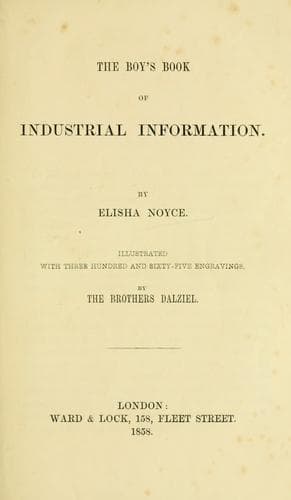
The Boy's Book of Industrial InformationNoyce, Elisha
General
The Boy's Book of Industrial Information
Noyce, Elisha
Industrial arts -- Juvenile literature; Technology -- Juvenile literature
the stems being bent into the desired form, they are carried to the
baking kiln, which is capable of firing fifty gross in from eight to
twelve hours. A workman and a child can easily make five gross of
pipes in a day.”
Illustration: FURNACE.
The pipes known as “meerschaum” are cut and shaped out of a natural
earth or mineral, found chiefly in the island of Samos; it is not a
clay, but consists of silica, magnesia, and lime, and is therefore
a kind of magnesian limestone. It is nearly white, very light and
porous, is easily cut with a knife, and bears a beautiful polish when
saturated with the oil of the tobacco, which at the same time gives
to the pipes a rich dark-brown color.
The meerschaum pipes sold in London are saturated with wax or grease,
to cause them to color more easily, and many are not meerschaum at
all, but are made of the dust produced in the cutting and boring
of the real meerschaum pipes, mixed up with size; these fictitious
pipes are heavier and less porous than the true meerschaum pipes, and
neither color so readily nor bear so beautiful a polish; they are,
moreover, much more easily broken.
GOLD-LEAF.
For the purpose of gilding very thin leaves of gold are required,
so thin, that although gold is expensive, yet gilded articles (as
picture-frames) are very far from being so. To produce this gold-leaf
is the business of the gold-beater. He first obtains the gold in a
state of purity from the refiner, in the form of small grains, which,
mixed with a small quantity of borax and alloy, are put into an
earthen pot called a crucible (coated beforehand with clay to keep
it from cracking), and then placed in a furnace which is raised to
a white heat. The gold, when melted, is poured into an iron mould
made warm and greased in the inside; this when cold forms an “ingot,”
which weighs two ounces, and is three-quarters of an inch square
and not quite half-an-inch thick. This ingot is now sent to the
“flattening mills,” where it is passed between sets of steel rollers
until it is rolled out into a sort of riband an inch wide and about
twelve feet long (at this degree of thinness a square inch will weigh
six-and-a-half grains). It is now cut into 150 pieces, each an inch
square, which are packed between pieces of vellum, four inches each
way, and surrounded by a sort of bag of the same material, the whole
being then subjected to the blows of a heavy iron hammer (weighing
about fourteen pounds) upon a block of solid stone, till the plates
of gold are beaten out nearly as large as the vellum, when they are
taken out and each cut into four pieces. These quarters are treated
as before, using gold-beater’s “skin” instead of vellum (this skin
is prepared from the intestines of the ox, and a set of these,
consisting of several hundreds, is called a “mould”), and the gold
again extended under the hammer to the size of the mould. The process
is repeated in the same manner a third time, after which the leaves
Public-domain text, read in full here on John Shaqi.
Reviews
Reviews
No reviews yet
Be the first to share your thoughts on this work.
Elsewhere in the archive
Join the Discussion
Join the discussion
Sign in to leave a comment or review.
Sign InorCreate an account