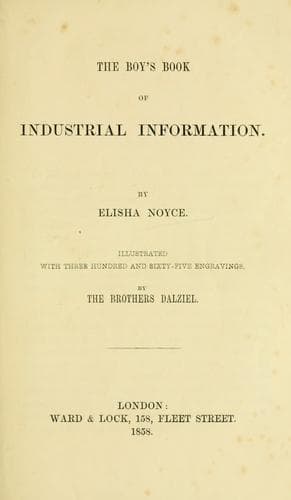
The Boy's Book of Industrial InformationNoyce, Elisha
General
The Boy's Book of Industrial Information
Noyce, Elisha
Industrial arts -- Juvenile literature; Technology -- Juvenile literature
of gold are taken out, cut square on a cushion of leather, lifted
carefully by means of a sort of tongs made of wood, and placed in
the book. They are now between 600 and 700 times thinner than before
the beating commenced, and it would take about 280,000 of these
leaves to make the thickness of an inch. The leaves are from three
to three-and-a-half inches square, and are packed in books of paper
having the surface of the leaves rubbed with red chalk, to prevent
them from adhering to the gold; each book contains twenty-five leaves
of gold.
The different colors of gold-leaf, such as “pale gold,” “deep gold,”
or “red gold,” are produced by a small alloy of copper or silver,
the former giving a deeper and the latter a paler tinge to the pure
gold. A certain amount of alloy is always mixed with the pure metal,
otherwise it would adhere to the mould, and would not work so well.
SHOT.
Illustration: SHOT TOWER.
Illustration: SIEVE FOR MAKING SHOT.
Illustration: SECTION OF SHOT-TOWER.
Shot are made either of iron or lead. All shot for great guns or
cannon are made of iron, but for small-arms leaden balls are used,
which are cast to fit the bore of the weapon. For sporting purposes
small shot are made, of different sizes; they consist of globules of
lead with a small proportion of arsenic mixed with it--the object
of mixing arsenic is to make the shot divide better, as it has been
found by experience that lead alone does not divide so well--this
mixture, while in a fluid state, is poured through a colander or
sieve made of iron and having the bottom perforated with small holes,
to suit the size of the shot to be made. These colanders are placed
at the top of a high building like a tower, and the melted metal
runs through the perforations in fine streams and separates into
single drops as it falls. At the bottom of the building the shots are
received in vessels of water, to cool them. In these vessels all the
little globules are not exactly of the same size, although the holes
in the colanders regulate this to a certain extent, moreover they are
not all round; they have, therefore, to be sorted, which is done by
placing the shot by handfuls upon a board slightly tilted, so that
the round ones roll to the bottom and are received in a box, those
that are crooked, &c., lag behind on the board, and are put aside to
be re-melted. The shot in the box have next to be sorted as to size;
this is done by means of two sieves; the holes of one sieve are a
little larger than the size of the shot required, and this retains
therefore all that are too large, the next has holes a little less
than the shot, and this retains the right size and lets all the shot
that are too small pass through; by these simple means the shot are
separated into many sizes, which are numbered. The shot have now
to be finished, which is done by turning them, mixed with a little
black-lead, in a sort of barrel, which gives them a beautiful black
Public-domain text, read in full here on John Shaqi.
Reviews
Reviews
No reviews yet
Be the first to share your thoughts on this work.
Elsewhere in the archive
Join the Discussion
Join the discussion
Sign in to leave a comment or review.
Sign InorCreate an account