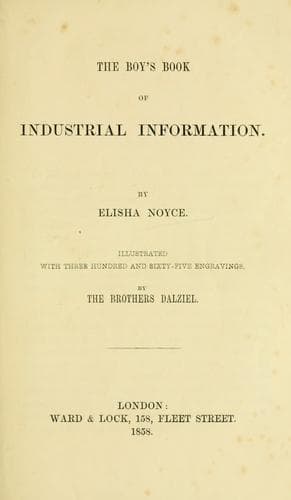
The Boy's Book of Industrial InformationNoyce, Elisha
General
The Boy's Book of Industrial Information
Noyce, Elisha
Industrial arts -- Juvenile literature; Technology -- Juvenile literature
The casting of types for printing is for the most part done by hand,
and singly, and it is one of those arts in which extreme dexterity
(only to be acquired by incessant practice) enables the founder
to accomplish an amount of labour which would seem to any one not
witnessing the process impossible. To cast each piece of type it
is necessary to dip a little ladle into a pot of melted metal,
to fill the mould, give it a sudden jerk with the left hand so as
to make the melted metal go well into the little mould, open the
mould and take the type out, shut up the mould and fasten it, and
yet a skilful workman can perform these operations five hundred
times in an hour--that is to say, rather more than eight times in
a minute--producing a type each time; this has afterwards to be
finished off by others. The metal of which type is made consists
of lead and antimony--the antimony hardens it and makes it take a
sharper impression. The letters are first cut in steel, and from
these “dies” the moulds are made in brass, by stamping, and in these
the types are cast.
Stereotype consists of plates of metal taken, by casting, from a
forme of type set up for the purpose; an impression in plaster of
Paris is first taken, and from this the metal impression is cast,
so that the original forme of type may be “distributed” or taken
to pieces, and again used, while the stereotyped impression can be
preserved for any future printing.
LUCIFER-MATCHES.
Illustration: FILLING THE BOXES.
These convenient matches, which have completely superseded the old
apparatus of flint, steel, and tinder-box, may be looked upon as
one of the improvements derived from chemistry, for phosphorus--the
necessary ingredient--till lately sold at half-a-crown an ounce;
such a price would, of course, prevent its being used for so
general a purpose as match-making. But when chemistry devised means
of preparing it on a large scale, and at a low price, then its
application was soon perceived.
Illustration: CUTTING THE MATCHES.
Illustration: FRAME.
Some years ago a kind of match was used, made of chlorate of potash
and sulphuret of antimony, and ignited by drawing through a folded
piece of glass-paper. Another sort was also for a time in use called
“Prometheans,” but far too expensive for general use. They consisted
of strips of paper rolled up, with a little glass cylinder full of
sulphuric acid sealed up in the end of each, surrounded by chlorate
of potash in powder; the end of the match had to be crushed by a
small pair of nippers, and the glass being broken, the sulphuric acid
came in contact with the chlorate of potash, causing it to take fire.
Illustration: FILLING THE FRAME.
Illustration: DIPPING THE MATCHES.
Public-domain text, read in full here on John Shaqi.
Reviews
Reviews
No reviews yet
Be the first to share your thoughts on this work.
Elsewhere in the archive
Join the Discussion
Join the discussion
Sign in to leave a comment or review.
Sign InorCreate an account