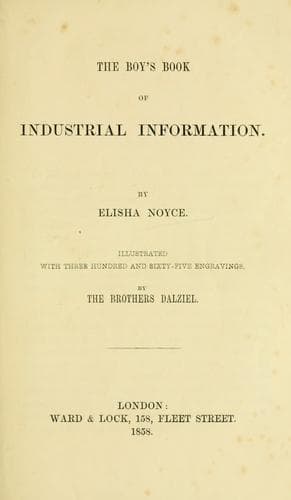
The Boy's Book of Industrial InformationNoyce, Elisha
General
The Boy's Book of Industrial Information
Noyce, Elisha
Industrial arts -- Juvenile literature; Technology -- Juvenile literature
shining surface, and rubs off any roughness.
FILES.
Illustration: FILE CUTTING.
Files are among the most useful of tools for those who work in
metals, and in many other substances, as ivory, or hard woods. A file
consists of a bar of steel of various shapes, such as flat, square,
three-cornered, round, and half-round; on the surface of this bar of
steel small furrows are formed, with rough projections between them,
and these are again, in most kinds of files, crossed with others.
The mode of making a file is as follows:--A bar of wrought or cast
steel is cut off of the requisite length and of the proper figure,
and forged on an anvil to the required shape--that is to say, rather
tapering at the top and brought to a point (called the “tang”) at the
bottom, so that it may be driven into a wooden handle. The file has
now to be cut. To do this requires great manual dexterity. A man sits
before a bench, and passes a strap over each end of the file so as
to steady it, and these are kept down with the feet. A small chisel
of hard steel is held in the left hand between the thumb and finger
and struck with a short-handled heavy hammer, the effect is to cut
a notch, with an elevation at each side called a “burr;” the small
chisel is slipped up to this “burr,” and struck again, and so on till
the whole file is cut, and this with such rapidity that the eye can
scarcely follow it. When the file is thus notched from end to end, it
has to be hardened, which is done by making it red-hot and suddenly
plunging it into cold water, which makes it so hard that it will
scratch glass and cut away any other metal.
Illustration: FILE.
Illustration: RASP.
For softer substances, such as wood, a kind of file is often used
called a “rasp,” which, instead of having furrows cut on it, is
struck into little dints by means of a three-cornered piece of hard
steel, which, as it enters the file, throws up a projection also.
For filing bone and ivory, a kind of file is used with very large
notches, not crossed by others, the edge of each of which acts like
a plane-iron or chisel, and takes off shavings from the bone.
TYPE.
Illustration: TYPE CASTING.
Public-domain text, read in full here on John Shaqi.
Reviews
Reviews
No reviews yet
Be the first to share your thoughts on this work.
Elsewhere in the archive
Join the Discussion
Join the discussion
Sign in to leave a comment or review.
Sign InorCreate an account