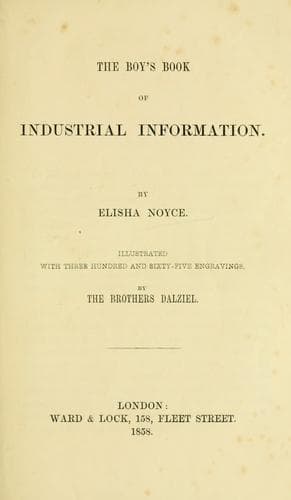
The Boy's Book of Industrial InformationNoyce, Elisha
General
The Boy's Book of Industrial Information
Noyce, Elisha
Industrial arts -- Juvenile literature; Technology -- Juvenile literature
Iron stands first in usefulness of all the metals, for railways,
bridges, ships, and a thousand other purposes; it can be both cast
and wrought, having that peculiar property, the capability of being
“welded,” that is to say, of softening while hot to such an extent
that when two pieces are made white hot and laid together, a few
blows of the hammer will cause them to unite into one piece, and it
is by means of this most useful quality that large masses of wrought
iron are produced, such, for instance, as anchors and cranks for
steam-boats. This property of welding, and the abundance of the ores
of iron, render it one of the most useful materials supplied by
nature for the various purposes of manufacture. In combination with
carbon it forms that hardly less useful article known by the name of
steel.
Cast Iron has scarcely any of the metallic lustre, and is only fitted
for solid work; it is brittle, like steel, without its elasticity,
and is too soft and too porous to be made into any of the numerous
tools and instruments for which steel is so eminently suitable.
Cast iron contains many impurities, the chief of which are carbon,
sulphur, and silica, got from the coke whilst being smelted in
contact with it, and from the fluxes used in the process; it is
coarse in grain, and much more fusible than wrought iron, which
is iron in a nearly pure state and can be fused only by the very
highest heat capable of being produced. Cast iron is converted into
wrought or malleable iron by being re-melted and stirred for a long
time in contact with the air, this process is called “puddling,”
its object is to get rid of all the impurities (chiefly carbon and
sulphur) which, by being brought into contact with the air at a high
temperature, are said to be burnt out, that is to say, they combine
with oxygen and form carbonic and sulphurous acids. After puddling,
the iron is rolled or hammered out, folded up, and again extended,
and as a general rule it may be said, the more this is continued the
purer and softer is the iron.
COPPER.
Illustration: NATIVE COPPER.
Copper is a reddish-coloured heavy metal, much used for sheathing
the under part of ships, for making boilers, &c. It is about
eight-and-a-half times heavier than water, and is too valuable to be
used for many purposes where either iron, tinned iron, or zinc are
applied, but for which purposes its great durability would fit it,
as it is easily rolled out or beaten into plates, and is not quickly
acted on by the weather. It is used as coin in pence, halfpence, and
farthings; all vessels for cooking purposes, when made of copper, are
tinned inside to prevent the food becoming poisonous from verdigris,
which is the rust of copper, and is very injurious. Copper is found
chiefly combined with sulphur, forming “native sulphuret of copper.”
Copper melts at a full red heat.
LEAD.
Illustration: SULPHURET OF LEAD.
Public-domain text, read in full here on John Shaqi.
Reviews
Reviews
No reviews yet
Be the first to share your thoughts on this work.
Join the Discussion
Join the discussion
Sign in to leave a comment or review.
Sign InorCreate an account