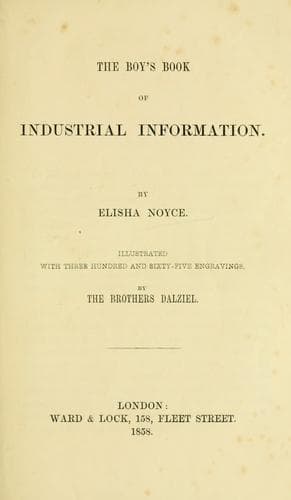
The Boy's Book of Industrial InformationNoyce, Elisha
General
The Boy's Book of Industrial Information
Noyce, Elisha
Industrial arts -- Juvenile literature; Technology -- Juvenile literature
The art of dyeing does not simply consist in coloring the different
substances; if this were the case, the color would be washed out as
easily as imparted. Nearly all the colors used in dyeing being of
vegetable origin, it is necessary to apply some substances to the
fabrics to be dyed which shall fix the colors in the grain. Of these
(called “mordants”) the chief are acetate of alumina, acetate of
iron, and chloride of tin (substances well known to chemists), which
have the property of making the coloring matter insoluble, so that it
cannot be washed out.
There are various ways of dyeing. If the fabric has to be dyed all
one color, it is dipped in the mordant, dried, and afterwards boiled
in a solution of the dye-stuff. If a colored ground with white
figures is required, then the figures are printed on it with what
is called a “resist,” that is, some substance thickened with gum,
paste, or pipe-clay, which will resist the action of the mordant and
dye-stuff, so that when the fabric is afterwards rinsed these figures
remain white. If the ground is to be white and the pattern dyed on
it, then this is printed with the mordant and the color adheres
only to the parts printed, although the whole be boiled with the
dye-stuff, what little may adhere to the ground being easily washed
out in the rinsing. Sometimes the kind of mordant used determines the
color of the dye; for instance, madder will dye red with the chloride
of tin, and black with the acetate of iron. If we now suppose a piece
of cloth to be printed in lines of acetate of iron, and figures of
chloride of tin, when the whole is boiled in the madder vat, the
cloth comes out with black lines and red figures on a white ground.
Another point to be considered is the kind of stuff to be dyed,
whether cotton, silk, or woollen, or a mixture of either, for what
will take one kind of dye will not always take another, and advantage
is taken of this to dye two colors at once, or part white and part
colored. A table-cover, for instance, woven with worsted and cotton,
can be boiled in various kinds of dye, and produce white and blue, or
white and red, for that dye is selected which will attach itself only
to one kind of fabric, and leave the other.
Illustration: SCOURING.
Many other chemical qualities of the substances used as dyes, and of
the substances to be dyed, are also taken into consideration. One of
the chief of these is shown in dyeing with indigo. This substance
(a vegetable extract) as brought to England is quite insoluble in
water and unfit for use as a dye; but it is made soluble, and at
the same time almost colorless, by mixing with lime, sulphate of
iron, and water. These substances deprive it of its oxygen, and the
straw-colored solution is then used for dyeing, the substances boiled
in it attaining--as the indigo regains its oxygen on exposure to the
air--a deep blue color.
Public-domain text, read in full here on John Shaqi.
Reviews
Reviews
No reviews yet
Be the first to share your thoughts on this work.
Elsewhere in the archive
Join the Discussion
Join the discussion
Sign in to leave a comment or review.
Sign InorCreate an account