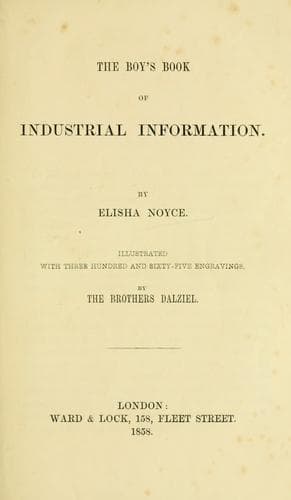
The Boy's Book of Industrial InformationNoyce, Elisha
General
The Boy's Book of Industrial Information
Noyce, Elisha
Industrial arts -- Juvenile literature; Technology -- Juvenile literature
With dyeing is often associated the art of “scouring,” for a
knowledge of the properties of the dye-stuffs used enables the
workman to discriminate between what will brighten and what would
injure the goods to be cleaned.
CALENDERING.
The process of calendering is resorted to for producing a fine
smooth surface on calicoes and other goods, and for rendering them
sufficiently even to be printed upon (see “Calico-printing”). The
calendering machine consists of a set of five rollers, constructed
to revolve at unequal rates, so that the one which turns upon the
face of the calico not only rolls it between itself and its fellow,
but--turning faster--_rubs_ it and gives a gloss to the surface
similar to the effect which would be produced if the goods were
laid on a table, and the roller rubbed over them instead of being
rolled. These rollers are very curiously constructed. They are made
by packing many hundreds of round pieces of pasteboard--having each
a square hole in the centre, and several smaller circular ones in the
margin--on to a central bar of iron, with similar bars through the
smaller holes, until a sufficient number have been added to produce
the length of roller required. Nuts are then fitted to the ends of
the smaller iron bars, and these being screwed tightly, compress the
whole into so solid a mass, that it can be turned in a lathe to a
perfectly smooth surface, which is (unlike wood) not liable to crack,
and, being slightly elastic, does not crush the goods, as metal
rollers would.
BREAD MAKING.
Public-domain text, read in full here on John Shaqi.
Reviews
Reviews
No reviews yet
Be the first to share your thoughts on this work.
Elsewhere in the archive
Join the Discussion
Join the discussion
Sign in to leave a comment or review.
Sign InorCreate an account