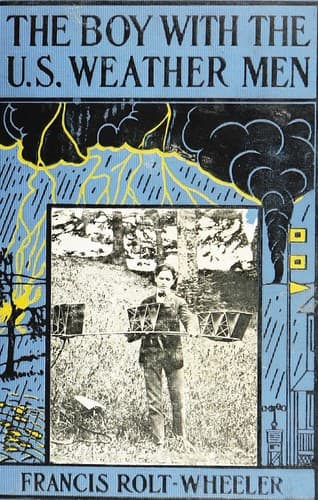
The Boy with the U. S. Weather MenRolt-Wheeler, Francis
General
The Boy with the U. S. Weather Men
Rolt-Wheeler, Francis
United States. Weather Bureau -- Juvenile literature
"The big lightning flashes that you see, boys, aren't always a single
flash, but often a whole series of flashes, which occasionally run up as
well as down. The resistance of the air being broken down, makes a path
for the electrical discharge, so that the conductor does not have to
stand the entire strain of the cloud at once, but only in a series of
discharges. Photographs of lightning flashes show these very clearly."
"I've never done any lightning photography," said Ralph disgustedly,
"I'd never thought of it."
"You try it," said the Forecaster, "and you'll find that there are no
two flashes of lightning that look alike. Some of them are several miles
long. One thing you will notice at once, Ralph, and that is that
lightning is never zigzag, the way you see it in pictures, but runs in
an irregular line, winding a little like a river-course."
"How about sheet-lightning?" asked Ralph.
"That's just the same as any other kind of lightning," was the reply,
"except that it doesn't come to the earth or is so distant that the
earth flash is not visible. It is generally due to discharges between
upper and lower clouds, and the lower clouds are illuminated by the
lightning. Heat-lightning, as it is called, is pretty much the same
thing."
"Father told me once," said Fred, "that during a thunder-storm, a ball
of fire came down on the chimney and rolled all around the room like a
bubble of quicksilver and then struck a shovel that was standing in the
corner, when it blew up with a bang. What was that, Mr. Levin?"
"That's globe, or ball lightning," was the reply. "There have been some
very curious freaks done with these electric balls. One of them, in a
baker's shop at Paris, jumped into an open oven door and exploded,
giving off so much heat that a pan of biscuits was baked in the fraction
of a second. At least, so Flammarion tells the story, though it sounds a
bit queer."
"But what's the cause of ball-lightning?"
"We don't know," answered the Forecaster, simply.
"A couple of days before the Galveston hurricane," put in the young
observer, "I noticed two or three examples of St. Elmo's fires, and even
had them from my fingers."
"What are St. Elmo's fires?" queried Fred.
"Corpse candles, they used to be called," the young observer answered,
"or St. John's fires. They are brush-like discharges of electricity,
being discharged from the earth towards the sky, and generally gather on
elevated points, such as the masts of ships, the tips of trees or the
iron railings around a roof. It was on the top of the Weather Bureau
building in Galveston that I saw them, just the other day. They look
like a bluish flame, and give a crackling sound. I had my hand on the
rail and was reaching up with the other hand towards the anemometer when
I noticed from my third and little fingers two blue flames burning. It
looked exactly as if my hand were alight."
"Weren't you afraid of being killed?" the boy asked.
Public-domain text, read in full here on John Shaqi.
Reviews
Reviews
No reviews yet
Be the first to share your thoughts on this work.
Elsewhere in the archive
Join the Discussion
Join the discussion
Sign in to leave a comment or review.
Sign InorCreate an account