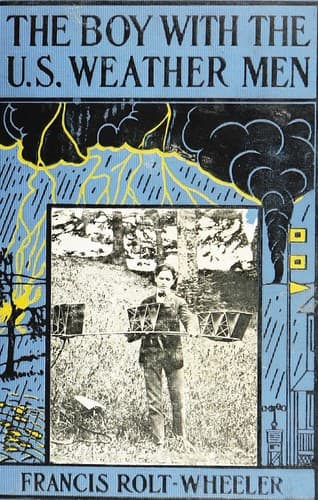
The Boy with the U. S. Weather MenRolt-Wheeler, Francis
General
The Boy with the U. S. Weather Men
Rolt-Wheeler, Francis
United States. Weather Bureau -- Juvenile literature
"No," said the observer, "that's not the way that one gets killed with
lightning. The St. Elmo's fire is a very weak electric discharge. My
fingers tingled a little, that was all."
"But do many people get killed with lightning?" queried Ross. "I thought
that it was really quite rare."
"Not as rare as you would think," the Forecaster answered. "About five
hundred people are killed by lightning every year in the United States
and there is an annual property loss of eight million dollars."
"Is that high as compared with other countries?" Anton asked.
"Yes," the Forecaster replied, "more people are killed by lightning in
the Western States than in any place in the world. In the Dakotas, out
of every million deaths twenty-seven are due to lightning; in Missouri,
twenty-one. In Hungary sixteen out of every million deaths are due to
lightning; in the United States as a whole, ten; in Germany, six; in
England, four; in France and Sweden, three, and in Belgium, two. The
greatest number of deaths by lightning are on the plains, the fewest in
the cities."
"I should think lightning would be much worse in the city," said Ross,
"because if a building is struck with a lot of people in it, they'd all
be killed."
The Forecaster shook his head.
"Not at all," he said. "Last year, for example, a church was struck by
lightning on a Sunday morning, during a religious service. There were
three hundred people in the building. It was a bolt of unusual force,
which practically wrecked the church. Only six people were killed by
lightning, thirty were injured from the falling timbers, seventy were
made unconscious by shock, and two hundred were absolutely uninjured.
"The largest number of persons killed by lightning at any one time in
America was in an amusement park in Chicago. Eleven people had huddled
into a zinc-lined hut under a pier, for protection from the rain. The
lightning struck the pier and jumped to the hut. If the hut had touched
the wet sand, none of them would have been hurt, but the hut was on
posts a couple of inches above the beach. The lightning could not escape
to the ground and it spread from the zinc sides, killing every one
there. A piece of wire a sixteenth of an inch thick and six inches long,
running from the hut into the ground, might have saved every life."
In the distance a flash of lightning followed by a low rumble of thunder
told of the nearer approach of the storm.
The Galveston observer took his watch from his pocket and counted the
seconds between the flash and the thunder.
"Fifty seconds!" he continued. "The front of the storm is still ten
miles away."
"Do you reckon five seconds to a mile between the lightning and the
thunder?" asked Anton.
"Yes," the observer replied, "light travels so fast that for something
as near as a lightning flash, you can reckon it as instantaneous, while
sound only travels at a little more than a thousand feet a second."
Public-domain text, read in full here on John Shaqi.
Reviews
Reviews
No reviews yet
Be the first to share your thoughts on this work.
Elsewhere in the archive
Join the Discussion
Join the discussion
Sign in to leave a comment or review.
Sign InorCreate an account