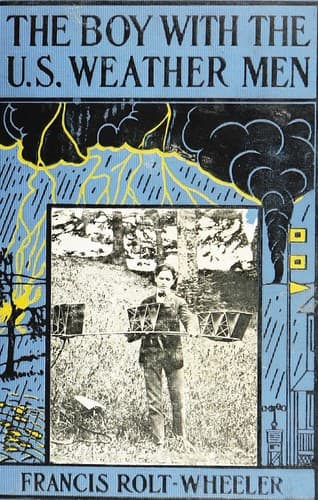
The Boy with the U. S. Weather MenRolt-Wheeler, Francis
General
The Boy with the U. S. Weather Men
Rolt-Wheeler, Francis
United States. Weather Bureau -- Juvenile literature
"It is, very often," the Forecaster answered. "In some very violent
electric storms, you'll see hail jump up as if it were alive, when it
strikes the earth. Of course, boys, there's some slight elasticity in a
hail-stone, too, because a good many of them are made like an onion or a
pearl, with a number of layers round each other."
"But why in the world should a hail-stone be made like an onion?" said
Fred, with a puzzled stare. "Isn't hail just frozen rain?"
"No," answered the Forecaster, "frozen rain is sleet, which is never
seen in summer. It is caused by the rain in the upper air falling
through a cold layer of surface air and becoming frozen on the way.
Sleet is ice, and transparent.
"Hail never falls in winter, only in summer, and almost always in
connection with a thunderstorm. It is made by drops of moisture, like
very fine rain, being carried by the strong upward currents of a
thunderstorm to altitudes where the air is very cold, there becoming
coated with a layer of snow, and becoming heavier, falling through the
less active upward currents on the edge of a storm. As these
snow-covered frozen raindrops fall through the clouds, they grow bigger,
because on their cold snow surfaces the moisture condenses and is frozen
to a skin of ice. At the base of the cloud, they are often sucked in by
the upward current and carried up again for another layer of snow,
falling again through the clouds and being covered with another skin of
ice. This may happen a dozen or a hundred times, the hailstones growing
in size with every successive layer of snow and ice, until at last they
become so heavy that they can no longer be carried up by the ascending
currents, and fall to the ground."
"No wonder hailstones sometimes get so big!" exclaimed Fred. "I've seen
them as big as pigeon's eggs. I never could understand it."
"I've seen hailstones that weighed more than half a pound," the
Forecaster answered. "Not so very long ago, two ranchers and six hundred
head of cattle were killed by hail in one Texas storm. Not a single
animal was left alive. The loss from hail in our Western states is so
large that most of the progressive farmers pay heavy hail insurance.
Jagged bits of hail the size of a child's fist are not at all uncommon.
If I'm not mistaken," he continued, "we may have some hail this
afternoon, but nothing like that. This county isn't in the regular
hail-belt."
During the description of the storm, Tom had been reeling in his kite
and after the week's observations had been duly made and recorded, the
boys prepared to scatter. Before they left, the Forecaster turned to
them, his hand on Anton's shoulder.
"I think you boys ought to know," he said, "that I received a letter the
other day from the Chief of the Weather Bureau. He's going down to New
Orleans next month, and has promised to drop off here and spend the
night with me. We were chums at college. He ought to meet the
Mississippi League of the Weather."
Public-domain text, read in full here on John Shaqi.
Reviews
Reviews
No reviews yet
Be the first to share your thoughts on this work.
Elsewhere in the archive
Join the Discussion
Join the discussion
Sign in to leave a comment or review.
Sign InorCreate an account