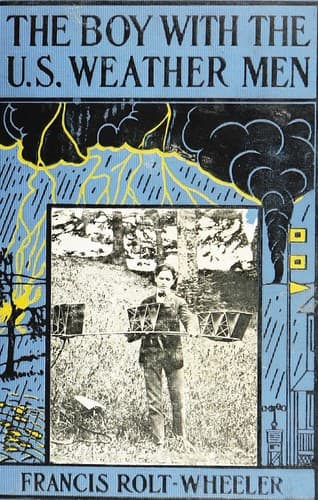
The Boy with the U. S. Weather MenRolt-Wheeler, Francis
General
The Boy with the U. S. Weather Men
Rolt-Wheeler, Francis
United States. Weather Bureau -- Juvenile literature
"But why does thunder make a noise?" asked Fred. "You told me the clouds
didn't bang together."
"They don't," the Forecaster answered. "Thunder is caused by the
electric discharge. You've heard Bob's big wireless outfit crackle, when
he sends out a spark, haven't you?"
"Sure," said Fred, "you can hardly hear yourself talk, when Bob's got
his wireless busy."
"And why does that crackle? Do you know, Bob?" he asked, turning to the
wireless expert.
"No," answered the boy.
"You've often heard the crackling of a near-by thunder compared to an
irregular volley of rifles, haven't you?"
"Yes."
"Naturally, because that's exactly what it is. A rifle shot is an
explosion caused by the firing of a powder, which, in turn, means the
expansion of the powder into gases, the force of that expansion driving
forward the bullet. Sound, as you know, is a series of air vibrations.
The explosion wave sets up a series of these vibrations, by compressing
the air in front of it.
"Lightning does the same thing. When a lightning flash breaks down the
resistance of the air, and passes through a channel of air, it heats the
air suddenly to a temperature of two or three thousand degrees, causing
a terrific expansion along the entire length of the flash and starting
an explosion wave. This compresses the air on all sides and sets sound
vibrations in action. As soon as the flash is discharged, the air rushes
back to fill the partial vacuum that the heating by electricity has
caused, adding force to the vibrations.
"That's why you hear the crackle of near-by thunder. You are near enough
to hear the explosions made by all the little side-branches of the
lightning flash--you can hear the same sometimes when you comb your hair
or rub a cat's fur--while the big crashes are due to your hearing, all
at once, the main wave of sound set in action by the flash jumping from
the cloud to the earth or from one cloud to another.
"The rumble of the thunder--which used to be thought the rolling of a
chariot in the sky, is due to the different distances of various
portions of the discharge, to the echo of the explosions from the
projecting hills and valleys of the cloud forms, and to the irregular
shape of the earth, when the sound waves strike the ground."
"Hail is electric, too, isn't it?" said Anton. "In a hail-storm the
other day I noticed that the hail jumped up a lot higher from an old
piece of iron that lay on the ground than from a stone right beside it.
I tried the iron and the stone with a marble, after the storm was over,
and the marble bounced higher from the stone. I figured that there must
be some kind of electric repulsion and that the hail must be
electrified."
Public-domain text, read in full here on John Shaqi.
Reviews
Reviews
No reviews yet
Be the first to share your thoughts on this work.
Elsewhere in the archive
Join the Discussion
Join the discussion
Sign in to leave a comment or review.
Sign InorCreate an account