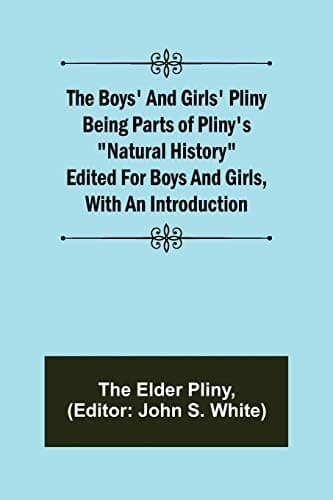
The Boys' and Girls' Pliny: Being parts of Pliny's "Natural History" edited for boys and girls, with an IntroductionPliny, the Elder
History
The Boys' and Girls' Pliny: Being parts of Pliny's "Natural History" edited for boys and girls, with an Introduction
Pliny, the Elder
Animals -- Juvenile literature; Natural history -- Juvenile literature; Physical sciences -- Juvenile literature
But it must be acknowledged, that everything which the earth has
produced, as a remedy for our evils, we have converted into the poison
of our lives. For do we not use iron, which we cannot do without, for
this purpose? But although this cause of mischief has been produced, we
ought not to complain; we ought not to be ungrateful to this one part of
nature. How many luxuries and how many insults does she not bear for us!
She is cast into the sea, and, in order that we may introduce seas into
her bosom, she is washed away by the waves. She is continually tortured
for her iron, her timber, stone, fire, corn, and is even much more
subservient to our luxuries than to our mere support. What indeed she
endures on her surface might be tolerated, but we penetrate also into
her bowels, digging out the veins of gold and silver, and the ores of
copper and lead; we also search for gems and certain small pebbles,
driving our trenches to a great depth. We tear out her entrails in order
to extract the gems with which we may load our fingers. How many hands
are worn down that one little joint may be ornamented! If the infernal
regions really existed, certainly these burrows of avarice and luxury
would have penetrated into them. And truly we wonder that this same
earth should have produced anything noxious! But, I suppose, the savage
beasts protect her and keep off our sacrilegious hands. For do we not
dig among serpents and handle poisonous plants along with those veins of
gold? But the Goddess shows herself more propitious to us, inasmuch as
all this wealth ends in crimes, slaughter, and war, and that, while we
drench her with our blood, we cover her with unburied bones; and being
covered with these and her anger being thus appeased, she conceals the
crimes of mortals. I consider the ignorance of her nature as one of the
evil effects of an ungrateful mind.
Every one agrees that it has the most perfect figure. We always speak of
the ball of the earth, and we admit it to be a globe bounded by the
poles. It has not indeed the form of an absolute sphere, from the number
of lofty mountains and flat plains; but if the termination of the lines
be bounded by a curve, this would compose a perfect sphere. And this we
learn from arguments drawn from the nature of things, although not from
the same considerations which we made use of with respect to the
heavens. For in these the hollow convexity everywhere bends on itself,
and leans upon the earth as its centre. Whereas the earth rises up solid
and dense, like something that swells up and is protruded outwards. The
heavens bend towards the centre, while the earth goes from the centre,
the continual rolling of the heavens about it forcing its immense globe
into the form of a sphere.
Public-domain text, read in full here on John Shaqi.
Reviews
Reviews
No reviews yet
Be the first to share your thoughts on this work.
Join the Discussion
Join the discussion
Sign in to leave a comment or review.
Sign InorCreate an account