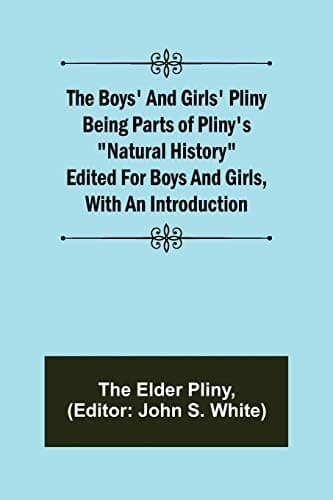
The Boys' and Girls' Pliny: Being parts of Pliny's "Natural History" edited for boys and girls, with an IntroductionPliny, the Elder
History
The Boys' and Girls' Pliny: Being parts of Pliny's "Natural History" edited for boys and girls, with an Introduction
Pliny, the Elder
Animals -- Juvenile literature; Natural history -- Juvenile literature; Physical sciences -- Juvenile literature
to wonder that he read and wrote no more than he did? For, on one side,
what obstacles would not the business of a court throw in his way? and
on the other, what might not such intense application effect? It amuses
me when I hear myself called a studious man, who in comparison with him
am the merest idler. But why do I mention myself, who am diverted from
these pursuits by numberless affairs both public and private? Who among
those whose whole lives are devoted to literary pursuits would not blush
and feel himself the most confirmed of sluggards by the side of him? I
see I have run out my letter farther than I had originally intended,
which was only to let you know, as you asked me, what works he had left
behind him. But I trust this will be no less acceptable to you than the
books themselves, as it may, possibly, not only excite your curiosity to
read his works, but also your emulation to copy his example, by some
attempts of a similar nature. Farewell.”
In his great work of thirty-seven books upon Natural History—the only
one which has come down to us—Pliny has compiled a vast encyclopædia of
all human knowledge of his time, comprising more than _twenty thousand
subjects_, and necessitating, as he himself states, the perusal of two
thousand volumes—almost all of which have perished—the works of five
hundred authors, to which he has added countless matters derived from
his personal enquiry, experience and observation. Among his enthusiastic
admirers in modern times are the eminent naturalists, Cuvier and Buffon.
The former in less extravagant but equally appreciative terms accords to
Pliny a high place among the writers of classical antiquity. “The work
of Pliny,” he says, “is one of the most precious monuments that have
come down to us from ancient times, and affords proof of an astonishing
amount of erudition in one who was a warrior and a statesman. To
appreciate with justice this vast and celebrated composition, it is
necessary to regard it in several points of view—with reference to the
plan proposed, the facts stated, and the style employed. The plan
proposed by the writer is of immense extent—it is his object to write
not simply a Natural History in our restricted sense of the term, not an
account merely, more or less detailed, of animals, plants, and minerals,
but a work which embraces astronomy, physics, geography, agriculture,
commerce, medicine, and the fine arts—and all these in addition to
natural history properly so called; while at the same time he
continually interweaves with his narrative information upon the arts
which bear relation to man considered metaphysically, and the history of
nations,—so much so indeed, that in many respects this work was the
Encyclopædia of its age. It was impossible in running over, however
cursorily, such a prodigious number of subjects, that the writer should
not have made us acquainted with a multitude of facts, which, while
remarkable in themselves, are the more precious from the circumstance
Public-domain text, read in full here on John Shaqi.
Reviews
Reviews
No reviews yet
Be the first to share your thoughts on this work.
Join the Discussion
Join the discussion
Sign in to leave a comment or review.
Sign InorCreate an account