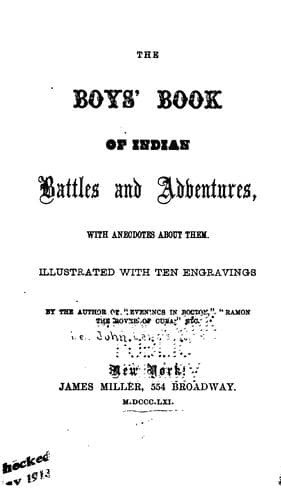
The boys' book of Indian battles and adventures, with anecdotes about them
History
The boys' book of Indian battles and adventures, with anecdotes about them
Indians of North America -- Anecdotes
Other faculties of a higher order are developed by the scenes amid which
the life of savages is spent. They are divided into a number of little
communities, between which are actively carried on all the relations
of war, negotiation, treaty, and alliance. As mighty revolutions,
observes an eloquent writer, take place in these kingdoms of wood and
cities of bark, as in the most powerful civilized states. To increase
the influence and extend the possessions of their own tribe, to humble
and, if possible, to destroy those hostile to them, are the constant
aims of every member of those little commonwealths. For these ends, not
only deeds of daring valour are achieved, but schemes are deeply laid,
and pursued with the most accurate calculation. There is scarcely a
refinement in European diplomacy to which they are strangers. The French
once made an attempt to crush the confederacy of the Five Nations by
attacking each in succession; but as they were on their march against
the first tribe, they were met by the deputies of the others, who
offered their mediation, intimating that, if it were rejected, they
would make common cause with the one threatened. That association also
showed that they completely understood how to employ the hostility
which prevailed between their enemy and the English for promoting their
own aggrandizement. Embassies, announced by the calumet of peace, are
constantly passing from one tribe to another.
The same political circumstances develop in an extraordinary degree the
powers of oratory; for nothing of any importance is transacted without
a speech. On every emergency a council of the tribe is called, when the
aged and wise hold long deliberations for the public weal. The best
speakers are despatched to conduct their negotiations, the object of
which is unfolded in studied harangues. The functions of orator, among
the Five Nations, had even become a separate profession, held in equal
or higher honour than that of the warrior; and each clan appointed the
most eloquent of their number to speak for them in the public council.
Nay, there was a general orator for the whole confederacy, who could say
to the French governor, “Ononthio, lend thine ear; I am the mouth of all
the country; you hear all the Iroquois in hearing my word.” Decanesora,
their speaker at a later period, was greatly admired by the English, and
his bust was thought to resemble that of Cicero. In their diplomatic
discourses, each proposition is prefaced by the delivery of a belt of
wampum, of which what follows is understood to be the explanation, and
which is to be preserved as a record of the conference. The orator does
not express his proposals in words only, but gives to every sentence
its appropriate action. If he threatens war, he wildly brandishes the
tomahawk; if he solicits alliance, he twines his arms closely with those
of the chief whom he addresses; and if he invites friendly intercourse,
Public-domain text, read in full here on John Shaqi.
Reviews
Reviews
No reviews yet
Be the first to share your thoughts on this work.
Elsewhere in the archive
Join the Discussion
Join the discussion
Sign in to leave a comment or review.
Sign InorCreate an account