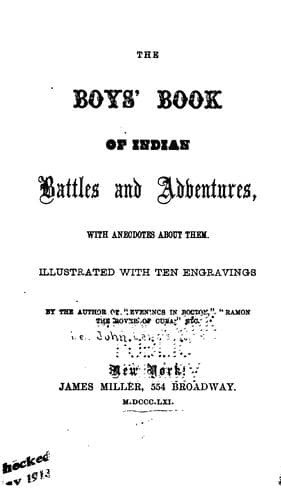
The boys' book of Indian battles and adventures, with anecdotes about them
History
The boys' book of Indian battles and adventures, with anecdotes about them
Indians of North America -- Anecdotes
he assumes all the attitudes of one who is forming a road in the Indian
manner, by cutting down the trees, clearing them away, and carefully
removing the leaves and branches. To a French writer, who witnessed the
delivery of a solemn embassy, it suggested the idea of a company of
actors performing on a stage. So expressive are their gestures, that
negotiations have been conducted and alliances concluded between petty
states and communities who understood nothing of one another’s language.
The composition of the Indian orators is studied and elaborate. The
language of the Iroquois is even held to be susceptible of an Attic
elegance, which few can attain so fully as to escape all criticism. It
is figurative in the highest degree, every notion being expressed by
images addressed to the senses. Thus, to throw up the hatchet or to put
on the great caldron is to begin a war; to throw the hatchet to the sky
is to wage open and terrible war; to take off the caldron or to bury
the hatchet is to make peace; to plant the tree of peace on the highest
mountain of the earth is to make a general pacification. To throw a
prisoner into the caldron is to devote him to torture and death; to take
him out, is to pardon and receive him as a member of the community.
Ambassadors coming to propose a full and general treaty say, “We rend
the clouds asunder, and drive away all darkness from the heavens, that
the sun of peace may shine with brightness over us all.” On another
occasion, referring to their own violent conduct, they said, “We are
glad that Assarigoa will bury in the pit what is past; let the earth
be trodden hard over it, or, rather, let a strong stream run under the
pit to wash away the evil.” They afterward added, “We now plant a tree,
whose top will reach the sun, and its branches spread far abroad, and we
shall shelter ourselves under it, and live in peace.” To send the collar
under ground is to carry on a secret negotiation; but when expressing a
desire that there might be no duplicity or concealment between them and
the French, they said that “They wished to fix the sun in the top of the
heaven, immediately above that pole, that it might beat directly down
and leave nothing in obscurity.” In pledging themselves to a firm and
steady peace, they declared that they would not only throw down the great
war-caldron, and cause all the water to flow out, but would break it in
pieces. This disposition to represent every thing by a sensible object
extends to matters the most important. One powerful people assumed the
appellation of Foxes, while another gloried in that of Cats. Even when
the entire nation bore a different appellation, separate fraternities
distinguished themselves as the tribe of the Bear, the Tortoise, and the
Wolf. They did not disdain a reference even to inanimate things. The
Black Caldron was at one time the chief warrior of the Five Nations; and
Red Shoes was a person of distinction well known to Long the traveller.
Public-domain text, read in full here on John Shaqi.
Reviews
Reviews
No reviews yet
Be the first to share your thoughts on this work.
Elsewhere in the archive
Join the Discussion
Join the discussion
Sign in to leave a comment or review.
Sign InorCreate an account